Advertisements
Advertisements
Question
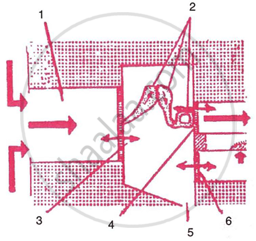
Given below is a diagrammatic representation of a part of the human ear.
- Name the parts numbered 1-6.
- Which parts of the ear shown here are complete.
 |
Advertisements
Solution
-
- Ear canal
- Ear ossicles
- Ear drum
- Oval window
- Eustachian tube
- Round windows
- Middle ear
APPEARS IN
RELATED QUESTIONS
Give scientific reasons: We cannot distinguish colours in moonlight.
Perilymph or endolymph (Which one surrounds the organ of Corti?)
Sclerotic layer or choroid layer (Which one forms the Iris?)
With reference to the human ear, answer the question that follow:
Name the part of the ear associated with
(1) static balance
(2) hearing
(3) dynamic balance.
Name the three tiny bones present in the middle part of ear.
What is the name of passage in outer ear which carries sound waves to the ear-drum ?
Given below is a diagram of a part of the human ear. Study the same and answer the question that follow:

Name the audio receptor region present in the part labeled 'A'.
Complete the following sentence with appropriate Word
The sequence of ear ossicles of vertebrates starting from the tympanum is:
Complete the following sentence with appropriate Word
The parts of the human ear concerned with hearing are :
The Eardrum moves inward when a rarefaction reaches it.
