Advertisements
Advertisements
Question
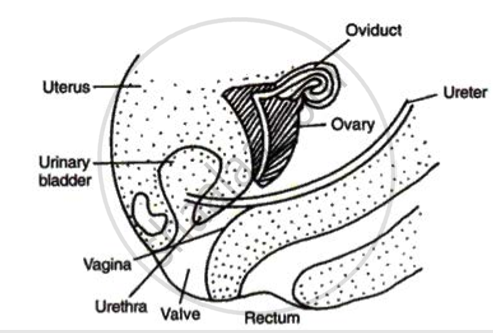
Given below is a diagram of the female reproductive system of a human being

(i) Name the parts numbered 1 to 6.
(ii) Normally after how many days does an ovary release an egg?
(iii) Where are the sperms released during coitus?
(iv) What do the sperms do after being released?
(v) What is the function of the organ numbered 5?
(vi) How many days does it normally take from the fertilization of the egg up to the birth of the baby?
Advertisements
Solution
(i)
1. Vagina
2. Right ovary
3. Ovarian funnel
4. Oviduct
5. Uterus
6. Cervix.
(ii) Normally the ovary releases one egg every 28 days by the rupture of the Graffian follicle.
(iii) The sperms are released by the penis in the vagina near the cervix.
(iv) The sperms swim up the vagina to enter through the cervix into the uterus and up into the oviduct where it meets the ovum.
(v) The function of the uterus is for the protection and nourishment of the embryo during the period of gestation.
(vi) The period of gestation is 266-280 days after which the fetus is expelled.
RELATED QUESTIONS
Give appropriate term for the following:
The onset of reproductive phase in a female.
Differentiate between:
Prostate gland and cowper’s gland (the nature of secretion)
Differentiate between Identical twins and fraternal twins.
The diagram alongside is the vertical section of female reproductive organs. Study the diagram and answer the questions that follow:
(i) Name the fully developed part of ovary containing the ovum.
(ii) Name the organ of the female body in which the foetus develops.
(iii) What is ovulation?
(iv) Which two hormones are secreted by ovary?
Complete the following statement by choosing the correct alternative:
Female copulatory organ ______.
Write the functional activity of the following structure:
Inguinal canal
Multiple Choice Question:
Sterilization in the female involves cuffing and tying the
After fertilization the ovary develops into ______.
State whether the following statement is True or False. If false, correct the statement:
In adult human females, a single mature egg is released into an oviduct every month.
What connects the embryo to the mother for nutrient and waste exchange till birth?
