Advertisements
Advertisements
Question
Give two examples of inertia kinds.
Advertisements
Solution
Examples of inertia of rest:
- Imagine a pile of books placed on a sheet of paper. If the paper is suddenly pulled with a jerk, the books are left behind, because of the inertia of rest.
- When a carpet is suddenly jerked, the dust flies off. Because of the sudden movement, the carpet moves, but dust on account of the inertia of rest is left behind.
Examples of inertia of motion:
- A man standing in a moving bus falls forward as soon as the bus stops, due to the inertia of motion of the upper part of his body.
- Before taking a long jump, a boy runs a certain distance, because in doing so he picks up the inertia of motion, which helps him in taking a longer leap.
Examples of inertia of direction:
- It is a common experience that passengers tend to fall sideways when a speeding bus takes a sharp turn. It is because, when the bus is moving along a straight line in a particular direction suddenly takes a sharp turn, the passengers on account of inertia of direction continue along their direction and hence fall sideways.
- The sparks produced during the sharpening of a knife against a grinding wheel leave the rim of the wheel tangentially because of the inertia of direction.
APPEARS IN
RELATED QUESTIONS
Name the property of bodies (or objects) to resist a change in their state of rest or of motion.
The mass of object A is 6 kg whereas that of another object B is 34 kg. Which of the two objects, A or B, has more inertia ?
With which physical quantity should the speed of a running bull be multiplied so as to obtain its momentum ?
Calculate the momentum of the following :
(a) an elephant of mass 2000 kg moving at 5 m/s
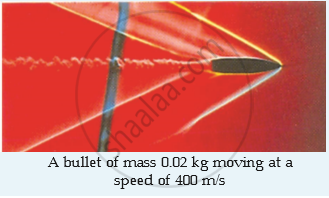
(b) a bullet of mass 0.02 kg moving at 400 m/s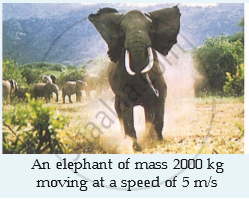
Describe the term ‘inertia’ with respect to motion.
The physical quantity which makes it easier to accelerate a small car than a large car is measured in the unit of :
The unit of measuring momentum of a moving body is :
What is Galileo's law of inertia?
Dust particles are removed from a carpet by beating it.
Inertia of a body depends on
