Advertisements
Advertisements
Question
Give some examples of fuel.
Advertisements
Solution
Wood, coal, cooking gas and petrol are examples of fuel.
RELATED QUESTIONS
Answer these question in a few words or a couple of sentence.
How old was Evelyn when she went to the Royal Academy of Music?
Answer these question in 30–40 words.
When and how did Bismillah Khan get his big break?
Thinking about the Poem
In stanza 1, find five ways in which we all are alike. Pick out the words.
Think of an occasion when you participated in a team competition. Think back on the leadership qualities displayed by your Team Leader/Captain. Recollect the specific incidents when those were displayed and how they contributed to the success of the team.
Write an e-mail to your mentor-teacher sharing this experience.
Parents alone are responsible for inculcating a good sense of dental hygiene amongst children. Do you agree/disagree? Discuss with your partner.
Discuss with your partner the similarities and differences between your dream houses.
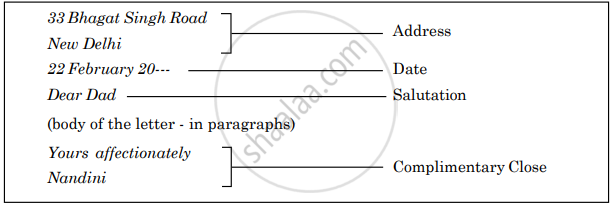
When we write informal letters (to a friend, or to a member of our family), we use this layout.
Now dramatise the play. Form groups of eight to ten students. Within each group, you will need to choose
- a director, who will be overall incharge of the group’s presentation.
- the cast, to play the various parts.
- someone to be in charge of costumes.
- someone to be in charge of props.
- a prompter.
Within your groups, do ensure that you
- read both scenes, not just your part within one scene if you are acting.
- discuss and agree on the stage directions.
- read and discuss characterization.
- hold regular rehearsals before the actual presentation.
Staging
The stage can be very simple, with exits on either side representing doors to the outside and to the rest of the house respectively.
What does he plant who plants a tree? a
He plants a friend of sun and sky;b
He plants the flag of breezes free;
The shaft of beauty, towering high;
He plants a home to heaven anigh;
For song and mother-croon of bird
In hushed and happy twilight heard____
The treble of heaven's harmony_____
These things he plants who plants a tree.
Read the lines given above and answer the question that follow:
The blocks were all lined up for those who would use them
The hundred-yard dash and the race to be run
These were nine resolved athletes in back of the starting line
Poised for the sound of the gun.
The signal was given, the pistol exploded
And so did the runners all charging ahead
But the smallest among them,he stumbled and staggered
And fell to the asphalt instead.
He gave out a cry in frustration and anguish
His dreams ands his efforts all dashed in the dirt
But as sure I'm standing here telling this story
The same goes for what next occurred.
Read the lines given above and answer the following question:
How were the dreams of one of the contestants ‘dashed in the dirt’?
But even as he approached the boy, Mr. Oliver sensed that something was wrong. The boy appeared to be crying. His head hung down, he held his face in his hands, and his body shook convulsively. It was a strange, soundless weeping, and Mr. Oliver felt distinctly uneasy.
Well, what’s the matter, he asked, his anger giving way to concern. What are you crying for? The boy would not answer or look up. His body continued to be wracked with silent sobbing.
Oh, come on, boy. You shouldn’t be out here at this hour. Tell me the trouble. Look up.
Read the extract given below and answer the question that follow.
When did Mr Oliver sense that there was something wrong?
Its a cruel thing to leave her so.”
“Then take her to the poorhouse: she’ll have to go there,” answered the blacksmith’s wife, springing away, and leaving Joe behind.
For a little while the man stood with a puzzled air; then he turned back, and went into the hovel again. Maggie with painful effort, had raised herself to an upright position and was sitting on the bed, straining her eyes upon the door out of which all had just departed, A vague terror had come into her thin white face.
“O, Mr. Thompson!” she cried out, catching her suspended breath, “don’t leave me here all alone!” ,
Though rough in exterior, Joe Thompson, the wheelwright, had a heart, and it was very tender in some places. He liked children, and was pleased to have them come to his shop, where sleds and wagons were made or mended for the village lads without a draft on their hoarded sixpences.
“No, dear,” he answered, in a kind voice, going to the bed, and stooping down over the child, “You she’n’t be left here alone.” Then he wrapped her with the gentleness almost of a woman, in the clean bedclothes which some neighbor had brought; and, lifting her in his strong arms, bore her out into the air and across the field that lay between the hovel and his home.
Read the extract given below and answer the question that follow.
What assurance did Joe Thompson give Maggie? What did he do?
In which situation is the lead held high? What does he mean by 'knowledge is free'? What are 'narrow domestic walls'?
How did the daimios reward the kind farmer?
What warning did the teachers give to Patrick?
Answer the following question.
What was the ‘game’ that every child in the school had to play?
Replace the italicised portion of the sentence below with a suitable phrase from the box. Make necessary changes, wherever required.
They criticised him in the meeting but he accepted without protest all the criticism.
How did the old aunt get justice?
Why does the poet say it is not good to be a rebel oneself?
Why were the hinges of the door rusty?
