Advertisements
Advertisements
Question
Give scientific reason.
Vertebrates have slowly originated from invertebrates.
Advertisements
Solution
- The Carbon dating technique used to assess the age of fossils indicated that invertebrates were present on the earth much before the vertebrates.
- Fossils of invertebrates are found buried deep as they are very old and belong to the Palaeozoic era.
- The Cenozoic era showed the presence of mammals and birds. Their fossils were seen in the upper strata of the earth’s crust.
- It was also observed that vertebrates are more complexed than invertebrates.
Therefore, it can be said that vertebrates have slowly originated from invertebrates.
APPEARS IN
RELATED QUESTIONS
Given below is the list of vegetables available in the market. Select from these the two vegetables having homologous structures:
Potato, sweet potato, ginger, radish, tomato, carrot, okra (Lady’s finger)
(A) Potato and sweet potato
(B) Radish and carrot
(C) Okra and sweet potato
(D) Potato and tomato
If you are asked to select a group of two vegetables, out of the following, having homologous structures which one would you select?
(a) Carrot and radish
(b) Potato and sweet potato
(c) Potato and tomato
(d) Lady finger and potato
State a reason for the increased population of dark coloured moths coinciding with the loss of lichens (on tree barks) during industrialization period in England.
Four students A, B, C and D reported the following set of organs to be homologous. Who is correct ?
(A) Wings of a bat and a butterfly
(B) Wings of a pigeon and a bat
(C) Wings of a pigeon and a butterfly
(D) Forelimbs of cow, a duck and a lizard
An example of homologous organs is
Enlist any four sequential evolutionary names of human ancestors.
Human tailbone is a vestigial organ. Explain.
The presence of which of the following types of organs in two animals indicates that they are not derived from a common ancestor?
(a) homologous organs
(b) excretory organs
(c) analogous organs
(d) reproductive organs
There are five animals A, B, C, D and E. The animal A uses its modified forelimbs for flying. The animal B uses its forelimbs for running whereas the animal C uses its forelimbs for grasping. The animal D can live on land as well as in water and uses its forelimbs to prop up the front end of its body when at rest. The animal E which respires by using spiracles and tracheae uses wings for flying but its wings are analogous to the modified forelimbs of animal A.
(a) What could the animals A, B, C, D and E be?
(b) Why are the forelimbs of animals A, B, C, D called homologous organs?
(c) What does the existence of homologous organs in animals A, B, C and D tell us about their ancestors ?
(d) Why are the modified forelimbs of animal A and the wings of animal E called analogous organs?
(e) State whether animals A and E have a common ancestor or not.
Explain with suitable examples importance of anatomical evidence in evolution.
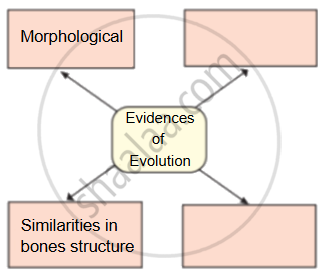
Complete the following chart:
Choose the correct option of the following question:
Wings of Insect and Birds are examples of :
What is carbon dating?
A human hand, a front leg of a cat, a front flipper of a whale and a bat’s wing look dissimilar and adapted for different functions. What is the name given to these organs?
Cucurbits do not develop thick and woody stem as they are:
Appearance of antibiotic-resistant bacteria is an example of ______.
The evolutionary story of moths in England during industrialisation reveals, that 'evolution is apparently reversible'. Clarify this statement.
Find odd one out:
Find the odd one out:
Complete the following conceptual picture:

