Advertisements
Advertisements
Question
Give one example of the reaction where order and molecularity are the same.
Mention any two factors that influence the rate of chemical reaction.
If for the reaction A → products, a straight line graph passing through origin is obtained between the rate of reaction against concentration of A, what would be the order of reaction? Why?
Advertisements
Solution
- \[\ce{2NO_{2(g)} -> 2NO_{2(g)} + O_{2(g)}}\]
The order of a reaction is 2 and its molecularity is also 2. - Temperature, use of catalyst
- The reaction would be first order.
The differential rate law for the first-order reaction A → products is
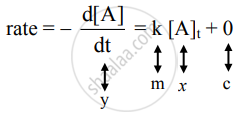
The equation is of the form y = mx + c. A plot of rate versus [A]t is a straight line passing through the origin. The slope of straight line = k.
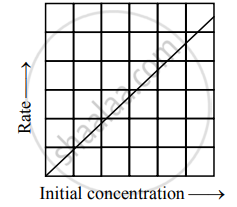
Variation of rate with [A]
APPEARS IN
RELATED QUESTIONS
Distinguish between Order and Molecularity of reaction.
Answer the following in one or two sentences.
What is the relationship between coefficients of reactants in a balanced equation for an overall reaction and exponents in the rate law? In what case the coefficients are the exponents?
A reaction takes place in two steps:
- \[\ce{NO_{(g)} + Cl2_{(g)} -> NOCl2_{(g)}}\]
- \[\ce{NOCl2_{(g)} + NO_{(g)} -> 2NOCl_{(g)}}\]
- Write the overall reaction.
- Identify the reaction intermediate.
- What is the molecularity of each step?
Which of the following is a unimolecular reaction?
Identify molecularity of following reaction:
\[\ce{C2H5I_{(g)} -> C2H_{4(g)} + HI_{(g)}}\]
Name the slowest step that determines the rate in a complex reaction.
Define molecularity.
Write an expression for instantaneous rate of reaction:
2N2O(g) → 4NO2(g) + O2(g).
What is the order of reaction?
Why is molecularity applicable for only elementary reactions whereas order of a reaction is applicable for elementary and complex reactions? Explain with suitable examples.
For the elementary reaction
\[\ce{2SO2(g) + O2(g) -> 2SO3(g)}\], identify the correct among the following relations.
The rate determining step of a reaction is the step ____________.
For the elementary reaction, \[\ce{3H2_{(g)} + N2_{(g)} -> 2NH3_{(g)}}\] identify the correct relation among the following relations.
For the reaction \[\ce{2NO2 + F2 -> 2NO2F}\], following mechanism has been provided:
\[\ce{NO2 + F2 ->[slow] NO2F + F}\]
\[\ce{NO2 + F ->[fast] NO2F}\]
The rate expression of the above reaction can be written as:
The reaction \[\ce{2NO2Cl_{(g)} -> 2NO2_{(g)} + Cl2_{(g)}}\] takes place in two steps as
(i) \[\ce{NO2Cl_{(g)} -> NO2_{(g)} + Cl_{(g)}}\]
(ii) \[\ce{NO2Cl_{(g)} + Cl_{(g)} -> NO2_{(g)} + Cl2_{(g)}}\]
Identify the reaction intermediate.
Consider the following elementary reaction;
\[\ce{2AB_{(g)} -> A2_{(g)} + B2_{(g)}}\]
The molecularity of the reaction is ____________.
Identify the molecularity of following elementary reaction:
NO(g) + O3(g) → NO3(g) + O(g)
The reaction takes place in two steps as
(i) \[\ce{NO2Cl(g) ->[k1] NO2(g) + Cl(g)}\]
(ii) \[\ce{NO2Cl(g) + Cl(g) ->[k2] NO2(g) + Cl2(g)}\]
Identify the reaction intermediate.
A certain reaction occurs in two steps as
(i) \[\ce{2SO2(g) + 2NO2(g) -> 2SO3(g) + 2NO(g)}\]
(ii) \[\ce{2NO(g) + O2(g) -> 2NO2(g)}\]
In the reaction:
What is an elementary reaction?
Find out the reaction intermediate and molecularity of the following reactions.
\[\ce{NO_{(g)} + Cl2_{(g)} -> NOCl_{2(g)}}\]
\[\ce{NOCl_{2(g)} + NO_{(g)} -> 2NOCl_{(g)}}\]
Draw the structure of BrF5 and HOCl.
A complex chemical reaction takes place in two steps.
Step I: NO(g) + O3(g) → NO3(g) + O(g)
Step II: NO3(g) + O(g) → NO2(g) + O2(g)
The predicted rate law is rate = k[NO][O3]
- Identify the rate determining step.
- Name the reaction intermediate/s. Why is/are it/these intermediate/s?
