Advertisements
Advertisements
Question
Give a brief description of the scientific discoveries made during the Renaissance period.
Advertisements
Solution
- Copernicus : Copernicus, a Polish priest (1473-1543) studied the celestial bodies and proved the theory of the rotation of the earth on its axis and its motion around the sun. His theory aroused great controversy, as it was considered an attack on the authority of the scriptures and of the Church.
- Galileo: Galileo, an Italian Astronomer (1564-1642) used a telescope, the greatest scientific instrument of the period, to study the movements of heavenly bodies for Copernicus’ theory. Galileo was tried by the Church1 for challenging its belief and authority. His book was burnt. Three years later, Giordano Bruno was burnt in Rome by the Church for insisting that the Earth goes around the Sun.
- Isaac Newton: Sir Isaac Newton, an English scientist of the 17th century proved that all the heavenly bodies move according to the law of gravitation. He enriched the field of mathematics with his scientific contributions.
- Medical Science: Significant discoveries were made in the field of medical sciences. Vesalius (1514-1564) wrote a treatise on the structure of the body (anatomy). William Harvey (1578-1637), an English physician, discovered the circulation of blood from the heart to all parts of the body and back to the heart.
Scientific discoveries and inventions encouraged rulers and wealthy men to advance the cause of science during the 17th century an Encyclopaedia of Scientific Knowledge came to be published.
APPEARS IN
RELATED QUESTIONS
Mention an outstanding impact of the Renaissance in the field of literature.
Who invented the Telescope?
The Renaissance artists tried to put life in canvas and stone. Describe their achievements in the fields of Painting
There was a splendid galaxy of scientific persons whose discoveries revolutionised our ideas of the universe. In this context mention the discoveries of the following men: Galileo
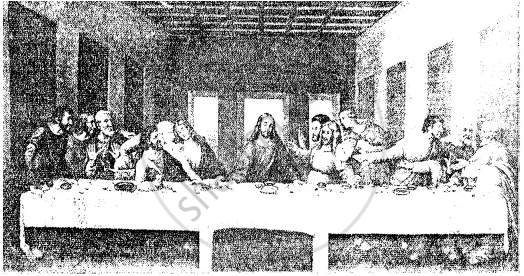
Study this picture carefully and answer the question that follows:

Give the name by which the portrait is known.
Study this picture carefully and answer the question that follows:
Mention the main features of this painting?
Who wrote “The Canterbury Tales”?
What do you understand by the term ‘Renaissance’?
Renaissance was a period of intellectual activity. In this context, write a short note on William Shakespeare
Study the picture given below and answer the following question:
Identify the painting and name the artist who made it.
