Advertisements
Advertisements
Question
From the top of a hill, the angles of depression of two consecutive kilometre stones due east are found to be 45° and 30° respectively. Find the height of the hill. [Take `sqrt(3) = 1.732`.]
Sum
Advertisements
Solution
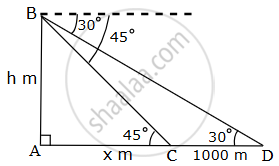
Let AB be the hill and let C and D be the two consecutive kilometre stones. Then,
∠ACB = 45°, ∠ADB = 30° and CD = 1 km = 1000 m.
Let AB =h m and AC = x m.
From right ΔBAC, we have
`(AC)/(AB) = cot 45^circ = 1`
⇒ `x/h = 1`
⇒ x = h ...(i)
From right ΔBAD, we have
`(AB)/(AD) = tan 30^circ = 1/sqrt(3)`
⇒ `h/(x + 1000) = 1/sqrt(3)`
⇒ `h/(h + 1000) = 1/sqrt(3)` ...[From (i)]
⇒ `(sqrt(3) - 1)h = 1000`
∴ `h = 1000/((sqrt(3) - 1))`
= `1000/((sqrt(3) - 1)) xx ((sqrt(3) + 1))/((sqrt(3) + 1))`
= `500 xx (sqrt(3) + 1)`
= (500 × 2.732) m
= 1366 m
shaalaa.com
Is there an error in this question or solution?
