Advertisements
Advertisements
Question
From the mid-point M of the side CD of a parallelogram ABCD, the line BM is drawn, intersecting AC at L and AD, produced at E. Prove that EL = 2BL.
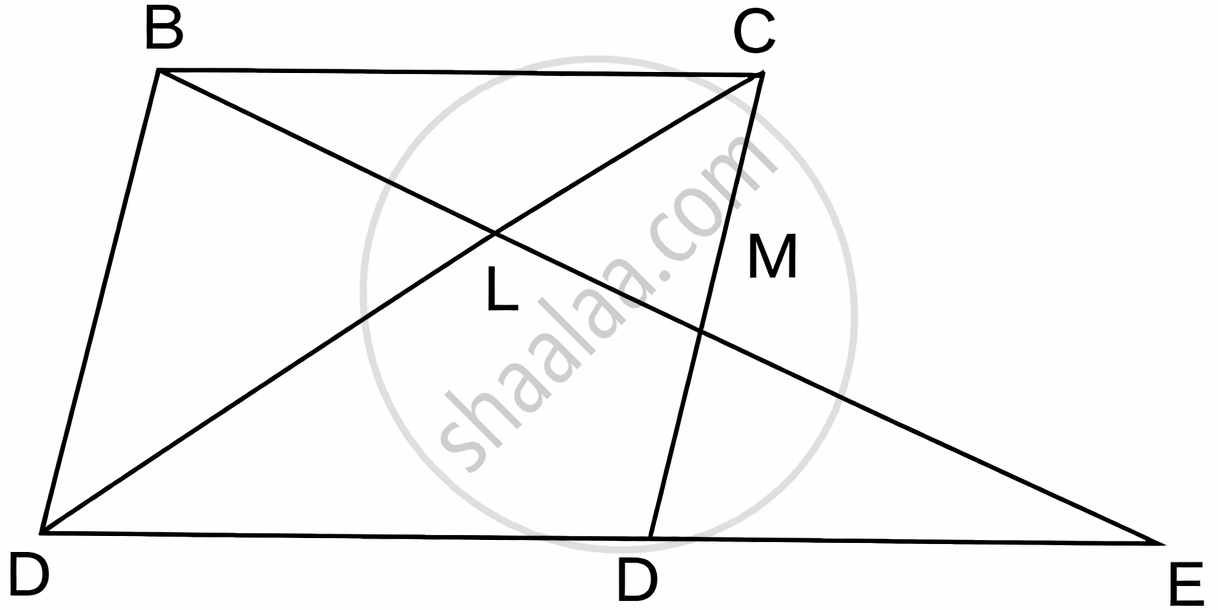
Sum
Advertisements
Solution
In parallelogram ABCD,
AB || CD, BC || AD, AB = CD, BC = AD
Also, M is the midpoint of CD, so
DM = MC
Since E lies on AD produced, DE || BC.
Also, B, M, and E are collinear.
Now consider △DEM and △CBM:
- ∠DME = ∠CMB (vertically opposite angles)
- ∠DEM = ∠CBM (alternate interior angles, since DE || BC)
- DM = MC (M is the midpoint of CD)
Therefore, △DEM ≅ △CBM by AAS.
Hence, by CPCT, DE = BC
But in parallelogram ABCD,
AD = BC
So, AE = AD + DE = BC + BC = 2BC
Now consider △ELA and △BLC:
- ∠ELA = ∠BLC (vertically opposite angles)
- ∠EAL = ∠BCL (since AE || BC and AL, CL lie on AC)
Thus, △ELA ∼ △BLC by AA similarity.
Therefore, `(EL)/(BL) = (EA)/(BC)`
Substituting EA = 2BC,
`(EL)/(BL) = (2BC)/(BC) = 2`
So,
EL = 2BL
Hence proved.
shaalaa.com
Is there an error in this question or solution?
