Advertisements
Advertisements
Question
From the given figure, name
(i) all pairs of parallel lines.
(ii) all pairs of intersecting lines.
(iii) pair of lines whose point of intersection is ‘V’.
(iv) point of intersection of the lines ‘l2‘ and ‘l3‘.
(v) point of intersection of the lines ‘l1‘, and ‘l5‘ 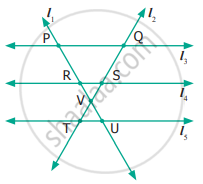
Advertisements
Solution
(i) l3 and l4, l4 and l5, l3 and l5
(ii) l1 and l2, l1 and l3, l1 and l4, l1 and l5, l2 and l3, l2 and l4, l2 and l5
(iii) l1 and l2
(iv) Q
(v) U
APPEARS IN
RELATED QUESTIONS
From the given figure, name the
(i) parallel lines
(ii) intersecting lines
(iii) points of intersection.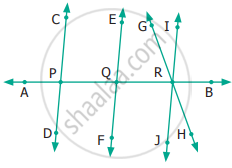
Find the type of lines marked in thick lines
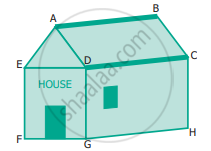
Find the type of lines marked in thick lines
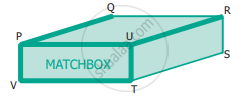
Find the parallel and intersecting line segments in the picture given below.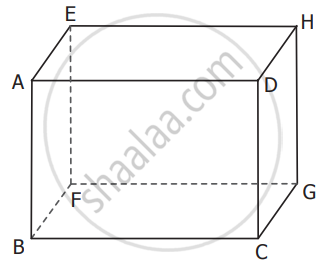
What is the disadvantage of comparing line segments by mere observation?
Why is it better to use a divider than a ruler, while measuring the length of a line segment?
Draw any line segment, say `overline"AB"`. Take any point C lying in between A and B. Measure the lengths of AB, BC, and AC. Is AB = AC + CB?
[Note: If A, B, and C are any three points on a line such that AC + CB = AB, then we can be sure that C lies between A and B.]
If A, B, and C are three points on a line such that AB = 5 cm, BC = 3 cm, and AC = 8 cm, which one of them lies between the other two?
Verify, whether D is the midpoint of `overline"AG"`.
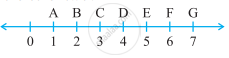
If B is the midpoint of `overline"AC"` and C is the midpoint of `overline"BD"`, where A, B, C, and D lie on a straight line, say why AB = CD?
