English

Forests are not responsible for - Science

Advertisements
Advertisements

Question

Forests are not responsible for

Options

  • providing medicinal plants.

  • maintaining the flow of water into the streams.

  • creating flood conditions.

  • absorbing rainwater and maintaining water table.

MCQ
Advertisements

Solution

creating flood conditions.

Explanation:

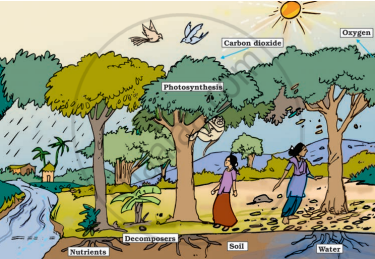
Forests prevent flooding. In a forest, raindrops do not hit the forest floor directly. The canopy layer of the forest intercepts the flow of raindrops so that rainwater falls on the leaves of trees and then drips slowly onto the forest floor. Thus, water does not collect and stagnate on the forest floor.

shaalaa.com
Forests: Our Lifeline
  Is there an error in this question or solution?
Chapter 17: Forests : Our Lifeline - MULTIPLE CHOICE QUESTIONS [Page 90]

APPEARS IN

NCERT Exemplar Science [English] Class 7
Chapter 17 Forests : Our Lifeline
MULTIPLE CHOICE QUESTIONS | Q 10. | Page 90

RELATED QUESTIONS

Explain why there is a need of variety of animals and plants in a forest.


Which of the following is not a use of forest?


Given below are a few statements related to biodiversity. Pick those that correctly describe the concept of biodiversity

  1. Biodiversity refers to the different species of flora and fauna present in an area
  2. Biodiversity refers to only the flora of a given area
  3. Biodiversity is greater in a forest
  4. Biodiversity refers to the total number of individuals of a particular species living in an area

Arabari forests of Bengal is dominated by


Boojho visited a forest near his town with his classmates and his teacher. As they were entering the forest, their class teacher told them not to make noise in the forest as noise could disturb the


Which among the following forest animals is the smallest?


Name any four useful products other than wood, which we get from forests.


All the needs of animals living in a forest are fulfilled. Justify this statement in a few sentences.


Name any two of the decomposers.


Visit a forest. Here is a list of points that would make your visit more fruitful.

  1. Make sure that you have permission to go into the forest.
  2. Make sure that you can find your way around. Get a map and go along with someone who is familiar with the area.
  3. Keep a record of the things you see and do. Observations make the visit interesting. Sketches and photographs are useful.
  4. You may record bird calls.
  5. Collect different kinds of seeds or hard fruits like nuts.
  6. Try to recognise various types of trees, shrubs, herbs, etc. Make lists of plants from different places in the forest and of different layers. You may not be able to name all the plants, but it is worth recording and seeing where they grow. Make a record of approximate heights of plants, crown shape, bark texture, leaf size, and flower colour.
  7. Learn to recognise the animal’s droppings.
  8. Interview the forest officials and the people of surrounding villages and other visitors.

You must never collect birds’ eggs, and their nests should never be disturbed.

You can read more on the following website:


Share
Notifications

Englishहिंदीमराठी


      Forgot password?
Use app×