Advertisements
Advertisements
Question
First, read the following sets of limericks with missing words. Now, listen to them being read out aloud by your teacher or played on the recorder. As you enjoy the absurd fun, complete the verse with what you hear. You may listen to them again, if required.
I
A wonderful bird is the (i) ______His beak can hold more than his (ii) ______can. He can hold in his beak Enough food for a (iii) ______! But I’ll be darned if I know how the Peli-can?
II
There once was a (iv) ______ at the zoo Who always had something to do When it (v) ______ him, you know, To go to and fro, He (vi) ______ it and went fro and to.
III
There once was a (vii) _______ little bunny Who I thought was sweet and (viii) ______ He ate all the carrots, And looked at the (ix) ______ And that was my cute little (x) ______.
Advertisements
Solution
I
A wonderful bird is the (i) pelican His beak can hold more than his (ii) belly can. He can hold in his beak Enough food for a (iii) week! But I’ll be darned if I know how the Peli-can?
II
There once was a (iv) bear at the zoo Who always had something to do When it (v) bored him, you know, To go to and fro, He (vi) reversed it and went fro and to.
III
There once was a (vii) cute little bunny Who I thought was sweet and (viii) funny He ate all the carrots, And looked at the (ix) Parrots And that was my cute little (x) bunny.
APPEARS IN
RELATED QUESTIONS
Read the poem aloud.
Form groups of three and read the conversation in the story aloud.
The drinking water is supplied by____________ lake to the city.
Listen to the passage about Nammazhwar, an environmental crusader from Tamil Nadu. As you listen, answer the following question. The listening act can be repeated if required.
What was the turning point in the life of Nammazhwar?
Listen to the passage about Nammazhwar, an environmental crusader from Tamil Nadu. As you listen, answer the following question. The listening act can be repeated if required
How is the “Bread sandwich method” a boon to the farmers?
State whether the statement is true or false.
The brothers have decided to borrow money for the wedding anniversary celebration.
You can make the payment either by __________ or __________.
She doesn’t like mobile phones.
Madhubani paintings are from ______state.
Do you know where the rarest and the most beautiful shells are found?
Announcement 1
What is the number of the flight?
The truck went over a stone.
The brass lamp was in the truck.
Red peppers have______.
Centuries ago Udagamandalam was called______.
Some of the negative effects of a mobile phone are:
(a) __________________
(b) __________________
(c) __________________
(d) __________________
A mobile phone is a threat to one’s privacy as ______.
What actions destroy the Earth? How will you change it?
Why do we wear helmet?
Listen and respond to the directions. Then circle the correct action words that you heard and performed.
| 1. |
(a) get up |
(b) sit down | (c) bend down | (d) stand |
| 2. | (a) ask | (b) hear | (c) tell | (d) shout |
| 3. | (a) drink | (b) chew | (c) swallow | (d) eat |
| 4. | (a) drive | (b) ride | (c) fly | (d) sail |
| 5. | (a) imitate | (b) act | (c) do | (d) perform |
| 6. | (a) put | (b) throw | (c) take | (d) keep |
| 7. | (a) read | (b) print | (c) draw | (d) write |
| 8. | (a) shake | (b) touch | (c) grab | (d) hold |
| 9. | (a) tell | (b) say | (c) ask | (d) read |
| 10. | (a) open | (b) close | (c) shut | (d) drag |
It is a game with two teams of _______ players.
Listen to the audio and respond to the following question.
The weather in England is ______.
Go for a morning walk. Listen to the sounds you hear like the rustling of leaves, the wind blowing, the chirping of birds, the sounds of footsteps.
Read out the following phrases aloud. Divide them into loud and softer sounds.
- clapping hands
- a worm moving
- stamping feet
- a bud blooming
- a butterfly flying
- a feather dropping
- an ant walking
- a car moving
- the wind blowing
- ssshhhh
- whisper
- tiptoe
- a leaf falling
| Loud sounds | Softer sounds |
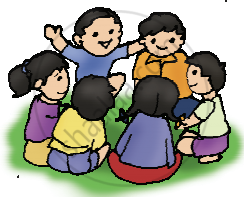
Form a circle and whisper a secret into the ear of the person on your right. He in turn whispers into the ear of the person on the right. Pass the secret on till it goes around the circle. The last person will tell the secret aloud. Is the secret the same as what the first child had whispered?
First, read the incomplete sentences given below. Listen to two interesting anecdotes about two scientists, that your teacher will read aloud or play on the recorder. Then, based on your understanding, complete the sentences suitably.
Thomas Alva Edison stepped from a train in Orange, New Jersey and walked down the platform. The station master knew how forgetful the famous inventor was. Therefore, he would always ask him a customary question. He asked Edison if he had left anything behind. Edison confidently replied that he had not left anything and everything was safe with him. Then, he began taking a count of his suitcases. As he was doing so, he happened to look up at the train. With a start, he dropped his bags and raced back to the car in which he had been travelling. What prompted that burst of activity was the face of his bride, with whom he had just married and returned from a honeymoon trip, staring from a window.
Albert Einstein was working at the Princeton University. One day when he was going back home he forgot his home address. The driver of the cab aid not recognize him. Einstein asked the driver if he knew Einstein’s home. The driver exclaimed that there could be no one who did not know Einstein’s address. He added that everyone in Princeton knew where Einstein lived and asked him if he wanted to meet Einstein. Einstein with a sheepish grin replied that he was Einstein and he had forgotten his residential address. He requested the cabbie if he could take him there. The astonished driver drove him home and dropped him safely. The cabbie considered driving Einstein a great honour and refused to charge him for the service.
- Edison travelled to New Jersey by ______.
- The station master enquired Edison if ______.
- Edison raced back to the car when he saw ______.
- Albert Einstein was working in ______.
- One day, when he was going back home, he ______.
- Einstein asked the cab driver if he knew ______.
- The driver was so good that he ______.
Now, you are going to listen to the cautionary instructions that are given to the general public living in flood-prone areas. Listen carefully and complete the following sentences.
Floods are an inevitable natural disaster that can occur in any part of the world. Floods can prove all the more disastrous in localities, where population density is high. Preparation for Disaster Management has become imperative for any city, town, or village during monsoons. The Government Department entrusted with Disaster Management makes periodic announcements about the precautions to be taken whenever floods are anticipated.
Now, you are going to listen to the cautionary instructions that are given to the general public living in flood-prone areas. Listen carefully and complete the following sentences. For the attention of the public, here is an announcement from the Department of Disaster Management. As per the warning issued today by the Meteorological Department, there exists a high probability of a widespread heavy downpour from the early hours of Sunday and consequent flooding of low-lying areas. In order to ensure the safety of life and property, everyone is hereby warned and advised to take certain precautionary measures:
- First of all, prepare a household flood plan and be ready to respond to the situation.
- Find out the locations of the closest flood shelters available and routes to reach them.
- Maintain an emergency kit comprising water bottles, biscuit packets, medical supplies, a torchlight, and a whistle to signal for help.
- Paste or fix a list of emergency telephone numbers on the wall in a visible spot.
- Switch off hazardous items like gas cylinders and disconnect electrical gadgets.
- Secure important personal documents and valuables in a waterproof case and place it in an accessible location.
- Place small pieces of furniture and clothing on tables and cots.
- Shift all the small objects safely to the loft.
- Empty your refrigerators and leave their doors open to avoid damage in case they float.
- Charge your mobile phones as well as your battery banks so as to communicate with friends, relatives, and emergency services.
- Place sandbags in the toilet bowls and bathroom drain holes to prevent sewage inflow.
- Prepare and pack food with a long shelf life.
- Finally, listen to the periodic news updates through your portable communication devices and follow the instructions implicitly.
- The announcement was made by the Department of ______.
- Widespread heavy rains are expected from the early hours of ______.
- The public is asked to find out the locations of ______.
- An emergency kit should contain water bottles, biscuit packets, and a ______.
- A list of ______should be displayed on the wall. f) Important documents can be secured by keeping them in a______ case.
- Damage to refrigerators can be avoided by ______.
- Mobile phones should be charged to enable the marooned to contact their friends, relatives and ______.
- ______should be placed in the toilet bowls to prevent sewage inflow.
- Listen to the ______and follow the instructions implicitly.
Listen carefully to the story being read out and answer the questions.
A boy was flying a kite with his father. He was excited to watch the kite soar high and asked his father, “What kept the kite up?” Dad replied “The String”. The boy said, “No dad, the string is holding the kite down.” The father suddenly broke the string, the kite came crashing down. Now the boy understood, what was holding the kite up. This is true in life as well. We are, advised to follow a set of rules or a prescribed code of conduct to enable us to reach our full potential. However, very often we hear the phrase “I want to be free.” If you take the train off the track, it is free. But where would it go? If each one of us follows our own traffic rules and drive on any side of the road what would you call it? Freedom or chaos? By observing rules we are actually gaining freedom. This is what. discipline is all about.
1. According to the father what kept the kite up?
- the kite itself
- air
- the string
- father’s skills
2. The string helped the kite to ______.
- withstand the pressure
- break free
- crash
- soar high
3. To realize our full potential, we should ______.
- obey our elders
- follow a set of rules
- work hard
- plan well
4. A train should go on the ______to reach its destination.
- track
- line
- road
- path
5. To realize our full potential, we should ______.
- obey our elders
- follow a set of rules
- work hard
- plan well
6. Taking freedom in our own hands will lead to ______.
- self-discipline
- chaos
- a code of conduct
- freedom
7. The main idea of the passage is ______.
- the art of flying kites
- father’s advice to his son
- the importance of discipline
- the right to freedom
