Advertisements
Advertisements
Question
Find the work done in bringing a charge q from perpendicular distance r1 to r2 (r2 > r1)
Advertisements
Solution
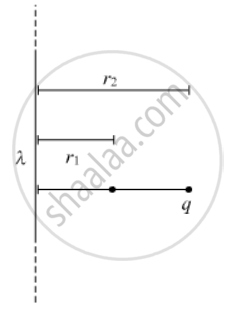
Let's suppose the charge is moved by an infinitely small distance dr. Small work is done in moving the charge, dw = qdV where V is the Potential difference between the two points.
Now, `dV = intE.dr = -int_(r1)^(r2) (lambdadr)/(2pirepsilon_0) = lambda/(2piepsilon_0) int_(r1)^(r2) (dr)/r = lambda/(2piepsilon_0) In [r_1/r_2]`
Work done = `qdv = (qlambda)/(2piepsilon_0) In [r_1/r_2]`
APPEARS IN
RELATED QUESTIONS
A 36 cm long sonometer wire vibrates with frequency of 280 Hz in fundamental mode, when it is under tension of 24.5 N. Calculate linear density of the material of wire.
A point charge of 2.0 μC is at the centre of a cubic Gaussian surface 9.0 cm on edge. What is the net electric flux through the surface?
A point charge q is at a distance of d/2 directly above the centre of a square of side d, as shown the figure. Use Gauss' law to obtain the expression for the electric flux through the square.

A closed surface in vacuum encloses charges –q and +3q. The total electric flux emerging out of the surface is :
Which statement is true for Gauss law -
Through two parallel wires A and B, 10A and 2A of currents are passed respectively in opposite directions. If the wire A is infinitely long and the length of the wire B is 2m, then force on the conductor B, which is situated at 10 cm distance from A, will be:
The electric field inside a spherical shell of uniform surface charge density is ______.
Sketch the electric field lines for a uniformly charged hollow cylinder shown in figure.

A solid metal sphere of radius R having charge q is enclosed inside the concentric spherical shell of inner radius a and outer radius b as shown in the figure. The approximate variation of the electric field `vecE` as a function of distance r from centre O is given by ______.
Draw a graph of kinetic energy as a function of linear charge density λ.
