हिंदी

Find the Work Done in Bringing a Charge Q from Perpendicular Distance R1 to R2 (R2 > R1) - Physics

Advertisements
Advertisements

प्रश्न

Find the work done in bringing a charge q from perpendicular distance r1 to r2 (r2 > r1)

Advertisements

उत्तर
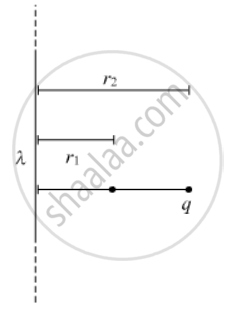
Let's suppose the charge is moved by an infinitely small distance dr. Small work is done in moving the charge, dw = qdV where V is the Potential difference between the two points.

Now, `dV = intE.dr = -int_(r1)^(r2)  (lambdadr)/(2pirepsilon_0) = lambda/(2piepsilon_0) int_(r1)^(r2) (dr)/r = lambda/(2piepsilon_0) In [r_1/r_2]`

Work done = `qdv = (qlambda)/(2piepsilon_0) In [r_1/r_2]`

shaalaa.com
  क्या इस प्रश्न या उत्तर में कोई त्रुटि है?
2017-2018 (March) Delhi Set 1

संबंधित प्रश्न

"For any charge configuration, equipotential surface through a point is normal to the electric field." Justify.


A point charge of 2.0 μC is at the centre of a cubic Gaussian surface 9.0 cm on edge. What is the net electric flux through the surface?


A point charge causes an electric flux of −1.0 × 10³ Nm2/C to pass through a spherical Gaussian surface of 10.0 cm radius centred on the charge.

  1. If the radius of the Gaussian surface were doubled, how much flux would pass through the surface?
  2. What is the value of the point charge?

State Gauss’ Law.


Two wires A and B of the same material and of equal length with the radii in the ratio 1 : 2 are subjected to identical loads. If the length of A increases by 8 mm, then the increase in length of B is:


Through two parallel wires A and B, 10A and 2A of currents are passed respectively in opposite directions. If the wire A is infinitely long and the length of the wire B is 2m, then force on the conductor B, which is situated at 10 cm distance from A, will be:


If the ratio of radii of two wires of same material is 3 : 1 and ratio of their lengths is 5 : 1, then the ratio of the normal forces that will produce the same extension in the length of two wires is:


Sketch the electric field lines for a uniformly charged hollow cylinder shown in figure.


  1. Obtain the expression for the electric field intensity due to a uniformly charged spherical shell of radius R at a point distant r from the centre of the shell outside it.
  2. Draw a graph showing the variation of electric field intensity E with r, for r > R and r < R.

An infinitely long positively charged straight wire has a linear charge density λ. An electron is revolving in a circle with a constant speed v such that the wire passes through the centre, and is perpendicular to the plane, of the circle. Find the kinetic energy of the electron in terms of the magnitudes of its charge and linear charge density λ on the wire.


Share
Notifications

Englishहिंदीमराठी


      Forgot password?
Use app×