Advertisements
Advertisements
Question
Find the value of k for which the system of equations 3x + y = 1 and kx + 2y = 5 has (i) a unique solution, (ii) no solution.
Advertisements
Solution
1. Identify the coefficients
Write the system of equations in the standard form a1x + b1y = c1 and a2x + b2y = c2:
Equation 1:
kx + 2y = 5
⇒ a1 = k, b1 = 2, c1 = 5
Equation 2:
3x + y = 1
⇒ a2 = 3, b2 = 1, c2 = 1
2. Condition for unique solution
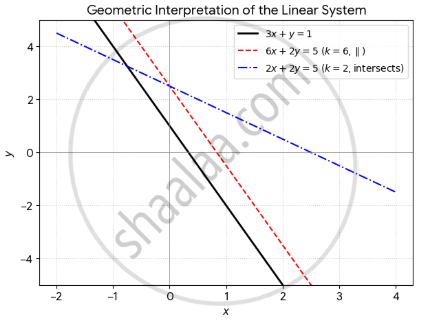
A linear system has a unique solution if the two lines intersect at exactly one point. This happens when the ratios of their coefficients are unequal:
`(a_1)/(a_2) ≠ (b_1)/(b_2)`
Substitute the values into the inequality:
`k/3 ≠ 2/1`
k ≠ 6
Thus, the system has a unique solution for all real numbers except k = 6.
3. Condition for no solution
The system has no solution if the two lines are parallel and never intersect. This occurs when the x and y coefficient ratios are equal, but different from the constant ratio:
`(a_1)/(a_2) = (b_1)/(b_2) ≠ (c_1)/(c_2)`
Substitute the values into the equation:
`k/3 = 2/1 ≠ 5/1`
From the first part:
`k/3 = 2`
⇒ k = 6
Since 2 ≠ 5, the condition `(b_1)/(b_2) ≠ (c_1)/(c_2)` is satisfied. Thus, the system has no solution when k = 6.