Advertisements
Advertisements
Question
Find the time period of mass M when displaced from its equilibrium position and then released for the system shown in figure.

Advertisements
Solution
For the calculation purpose. in this situation, we will neglect gravity because it is constant throughout and will not affect the net restoring force.
Let in the equilibrium position, the spring has extended by an amount x0.
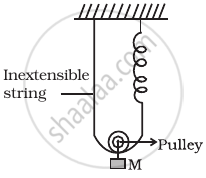
Now, if the mass is given a further displacement downwards by an amount of x. The string and spring both should increase in length by x.
But. string is inextensible, hence the spring alone will contribute the total extension x + x = 2x, to lower the mass down by x from the initial equilibrium mean position x0. So, net extension in the spring (= 2x + x0)
Now force on the mass before bullying (in the x0 extension case)
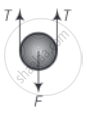
F = 2T
But T = kx0 ......[Where k is spring constant]
∴ F = 2kx0 ......(i)
When the mass is lowered further by x,
F' = 2T'
But new spring length = (2x + x0)
∴ F' = 2k(2x + x0) ......(ii)
Restoring force on the system
`F_"restoring" = - [F^' - F]`
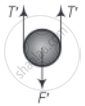
Using equations (i) and (ii), we get
`F_"restoring" = -[2k(2x + x_0) - 2kx_0]`
= `- [2 xx 2kx + 2kx_0 - 2kx_0]`
= `- 4kx`
or Ma = `- 4kx`
Where, a = acceleration .....(As, F = ma)
⇒ a = `- ((4k)/M)x`
k, M is constant.
∴ a ∝ – x
Hence, the motion is S.H.M
Comparing the above acceleration expression with standard SHM equation a = – ω2x, we get
`ω^2 = (4k)/M`
⇒ `ω = sqrt((4K)/M)`
∴ Time period T = `(2pi)/ω = (2pi)/sqrt((4K)/M) = 2pi sqrt(M/(4k))`
APPEARS IN
RELATED QUESTIONS
The period of a conical pendulum in terms of its length (l), semi-vertical angle (θ) and acceleration due to gravity (g) is ______.
The phase difference between displacement and acceleration of a particle performing S.H.M. is _______.
(A) `pi/2rad`
(B) π rad
(C) 2π rad
(D)`(3pi)/2rad`
let us take the position of mass when the spring is unstretched as x = 0, and the direction from left to right as the positive direction of the x-axis. Give x as a function of time t for the oscillating mass if at the moment we start the stopwatch (t = 0), the mass is
(a) at the mean position,
(b) at the maximum stretched position, and
(c) at the maximum compressed position.
In what way do these functions for SHM differ from each other, in frequency, in amplitude or the initial phase?
Answer the following questions:
A time period of a particle in SHM depends on the force constant k and mass m of the particle: `T = 2pi sqrt(m/k)` A simple pendulum executes SHM approximately. Why then is the time
A simple pendulum of length l and having a bob of mass M is suspended in a car. The car is moving on a circular track of radius R with a uniform speed v. If the pendulum makes small oscillations in a radial direction about its equilibrium position, what will be its time period?
A clock regulated by seconds pendulum, keeps correct time. During summer, length of pendulum increases to 1.005 m. How much will the clock gain or loose in one day?
(g = 9.8 m/s2 and π = 3.142)
Show that, under certain conditions, simple pendulum performs the linear simple harmonic motion.
If the maximum velocity and acceleration of a particle executing SHM are equal in magnitude, the time period will be ______.
The period of oscillation of a simple pendulum of constant length at the surface of the earth is T. Its time period inside mine will be ______.
A particle executing S.H.M. has a maximum speed of 30 cm/s and a maximum acceleration of 60 cm/s2. The period of oscillation is ______.
When will the motion of a simple pendulum be simple harmonic?
A body of mass m is situated in a potential field U(x) = U0 (1 – cos αx) when U0 and α are constants. Find the time period of small oscillations.
A cylindrical log of wood of height h and area of cross-section A floats in water. It is pressed and then released. Show that the log would execute S.H.M. with a time period. `T = 2πsqrt(m/(Apg))` where m is mass of the body and ρ is density of the liquid.
A tunnel is dug through the centre of the Earth. Show that a body of mass ‘m’ when dropped from rest from one end of the tunnel will execute simple harmonic motion.
In the given figure, a mass M is attached to a horizontal spring which is fixed on one side to a rigid support. The spring constant of the spring is k. The mass oscillates on a frictionless surface with time period T and amplitude A. When the mass is in equilibrium position, as shown in the figure, another mass m is gently fixed upon it. The new amplitude of oscillation will be:

A pendulum of mass m and length ℓ is suspended from the ceiling of a trolley which has a constant acceleration a in the horizontal direction as shown in the figure. Work done by the tension is ______.
(In the frame of the trolley)

A particle at the end of a spring executes simple harmonic motion with a period t1, while the corresponding period for another spring is t2. If the period of oscillation with the two springs in series is T, then ______.
If the mass of the bob in a simple pendulum is increased to thrice its original mass and its length is made half its original length, then the new time period of oscillation is `x/2` times its original time period. Then the value of x is ______.
