Advertisements
Advertisements
Question
Find the mean proportional between `6 + 3sqrt(3)` and `8 - 4sqrt(3)`
Advertisements
Solution
Let the mean proportional between `6 + 3sqrt(3)` and `8 - 4sqrt(3)` be x.
`\implies 6 + 3sqrt(3), x` and `8 - 4sqrt(3)` are in continued proportion.
`\implies 6 + 3sqrt(3) : x = x : 8 - 4sqrt(3)`
`\implies x xx x = (6 + 3sqrt(3)) (8 - 4sqrt(3))`
`\implies x^2 = 48 + 24sqrt(3) - 24sqrt(3) - 36`
`\implies x^2 = 12`
`\implies x = 2sqrt(3)`
RELATED QUESTIONS
Which number should be subtracted from 12, 16 and 21 so that resultant numbers are in continued proportion?
Find the fourth proportional to 3, 12, 15
Find the value of x in each of the following proportions:
51 : 85 : : 57 : x
If b is the mean proportional between a and c, prove that (ab + bc) is the mean proportional between (a² + b²) and (b² + c²).
If a, b, c and d are in proportion, prove that: `(a^2 + b^2)/(c^2 + d^2) = "ab + ad - bc"/"bc + cd - ad"`
Choose the correct answer from the given options :
If x, 12, 8 and 32 are in proportion, then the value of x is
5 : `square` : : 10 : 8 : : 15 : `square`
If b : a = c : d, then a, b, c, d are in proportion.
Sleeping time of a python in a 24 hour clock is represented by the shaded portion in the following figure.
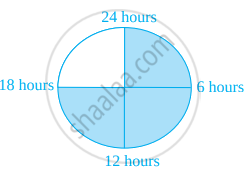
The ratio of sleeping time to awaking time is ______.
10 g of caustic soda dissolved in 100 mL of water makes a solution of caustic soda. Amount of caustic soda needed for 1 litre of water to make the same type of solution is ______.
