Advertisements
Advertisements
Question
Find the foot of the perpendicular drawn: from the point (5, 4, 2) to the line `(x + 1)/2 = (y - 3)/3 = (z - 1)/(-1)`. Also, find the equation of the perpendicular
Advertisements
Solution
`vec"r" = vec"a" + "t"vec"b"`
`vec"a" = -vec"i" + 3vec"j" + vec"k"`
`vec"b" = 2vec"i" + 3vec"j" - vec"k"`
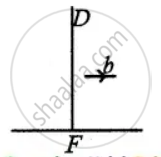
Given points D(5, 4, 2) to the point A.
If P is the foot of the perpendicular from to the straight line.
F is of the form
(2t – 1, 3t + 3, -t + 1) and
`vec"DF" = vec"OF" - vec"OD" = (2"t" - 6)vec"i" + (3"t" - 1)vec"j" + (-"t" - l)vec"k"`
`vec"b"` is perpendicular to `vec"DF"`, we have
4t- 12 + 9t – 3 + t + 1 = 0
14t – 14 = 0
14t = 14
t = 1
∴ F(2 – 1, 3 + 3, -1 + 1) = F(1, 6, 0) is foot point.
Equation of the perpendicular.
(x1, y1, z1) = (5, 4, 2), (x2, y2, z2) = (1, 6, 0).
`(x - x_1)/(x_2 - x_1) = (y - y_1)/(y_2 - y_1) = (z - z_1)/(z_2 - z_1)`
`(x - 5)/(1 - 5) = (y - 4)/(6 - 4) = (z - 2)/(0 - 2)`
⇒ `(y - 4)/2 = (z - 2)/(-2)`
APPEARS IN
RELATED QUESTIONS
Find the non-parametric form of vector equation and Cartesian equations of the straight line passing through the point with position vector `4hat"i" + 3hat"j" - 7hat"k"` and parallel to the vector `2hat"i" - 6hat"j" + 7hat"k"`
Find the points where the straight line passes through (6, 7, 4) and (8, 4, 9) cuts the xz and yz planes
Find the direction cosines of the straight line passing through the points (5, 6, 7) and (7, 9, 13). Also, find the parametric form of vector equation and Cartesian equations of the straight line passing through two given points
Find the acute angle between the following lines.
`vec"r" = (4hat"i" - hat"j") + "t"(hat"i" + 2hat"j" - 2hat"k")`
Find the acute angle between the following lines.
`(x + 4)/3 = (y - 7)/4 = (z + 5)/5, vec"r" = 4hat"k" + "t"(2hat"i" + hat"j" + hat"k")`
Find the acute angle between the following lines.
2x = 3y = – z and 6x = – y = – 4z
f the straight line joining the points (2, 1, 4) and (a – 1, 4, – 1) is parallel to the line joining the points (0, 2, b – 1) and (5, 3, – 2) find the values of a and b
If the straight lines `(x - 5)/(5"m" + 2) = (2 - y)/5 = (1 - z)/(-1)` and x = `(2y + 1)/(4"m") = (1 - z)/(-3)` are perpendicular to ech other find the value of m
Show that the points (2, 3, 4), (– 1, 4, 5) and (8, 1, 2) are collinear
Find the parametric form of vector equation and Cartesian equations of straight line passing through (5, 2, 8) and is perpendicular to the straight lines `vec"r" = (hat"i" + hat"j" - hat"k") + "s"(2hat"i" - 2hat"j" + hat"k")` and `vec"r" = (2hat"i" - hat"j" - 3hat"k") + "t"(hat"i" + 2hat"j" + 2hat"k")`
Show that the lines `vec"r" = (6hat"i" + hat"j" + 2hat"k") + "s"(hat"i" + 2hat"j" - 3hat"k")` and `vec"r" = (3hat"i" + 2hat"j" - 2hat"k") + "t"(2hat"i" + 4hat"j" - 5hat"k")` are skew lines and hence find the shortest distance between them
If the two lines `(x - 1)/2 = (y + 1)/3 = (z - 1)/4` and `(x - 3)/1 = (y - "m")/2` = z intersect at a point, find the value of m
Show that the straight lines x + 1 = 2y = – 12z and x = y + 2 = 6z – 6 are skew and hence find the shortest distance between them
Find the parametric form of vector equation of the straight line passing through (−1, 2, 1) and parallel to the straight line `vec"r" = (2hat"i" + 3hat"j" - hat"k") + "t"(hat"i" - 2hat"j" + hat"k")` and hence find the shortest distance between the lines
Choose the correct alternative:
If `[vec"a", vec"b", vec"c"]` = 1, then the value of `(vec"a"*(vec"b" xx vec"c"))/((vec"c" xx vec"a")*vec"b") + (vec"b"*(vec"c" xx vec"a"))/((vec"a" xx vec"b")*vec"c") + (vec"c"*(vec"a" xx vec"b"))/((vec"c" xx vec"b")*vec"a")` is
Choose the correct alternative:
I`vec"a" xx (vec"b" xx vec"c") = (vec"a" xx vec"b") xx vec"c"`, where `vec"a", vec"b", vec"c"` are any three vectors such that `vec"b"*vec"c" ≠ 0` and `vec"a"*vec"b" ≠ 0`, then `vec"a"` and `vec"c"` are
