Advertisements
Advertisements
Question
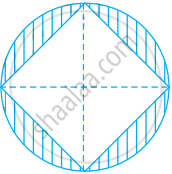
Find the area of the shaded portion in a circle whose radius is 7 cm (see figure).
[Hint: Four right-angled triangles joined at right angles to form a square]
Advertisements
Solution

Given that ABCD is a square
According to the question,
Area of square ABCD = 4 × Area of a right-angled triangle
∴ Area of square ABCD = 4 × Area of ΔAOB
= `4 xx (1/2 xx AO xx BO)` ...`[∵ "Area of a right angled triangle" = 1/2 xx "Base" xx "Height"]`
= 2 × 7 × 7
= 98 cm2 ...[∵ AO = BO = radius of circle = 7 cm, given]
Hence, the area of inscribed square is 98 cm2.
Area of shaded portion = Area of circle – Area of square
= πr2 – 98
= `22/7 xx 7 xx 7 - 98`
= 154 – 98
= 56 cm2
APPEARS IN
RELATED QUESTIONS
The length and the breadth of a rectangular piece of land are 500 m and 300 m respectively. Find the cost of the land, if 1 m2 of the land costs Rs 10,000.
Find the breadth of a rectangular plot of land, if its area is 440 m2 and the length is 22 m. Also find its perimeter.
The perimeter of a rectangle is 130 cm. If the breadth of the rectangle is 30 cm, find its length. Also find the area of the rectangle.
Find the area of a square plot of side 8 m.
The length of the side of a square is given below. Find its area
15 metres
Explain how the green area is 4 square cm and the yellow area is 6 square cm.

The area of each square on a chess board is 4 sq cm. Find the area of the board.
- At the beginning of game when all the chess men are put on the board, write area of the squares left unoccupied.
- Find the area of the squares occupied by chess men.
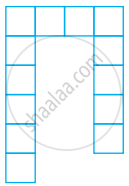
Find the area and perimeter of the following figure, if area of small square is 1 sq cm.
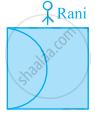
Rani bought a new field that is next to one she already owns (see figure). This field is in the shape of a square of side 70 m. She makes a semi-circular lawn of maximum area in this field.
- Find the perimeter of the lawn.
- Find the area of the square field excluding the lawn.
What is the formula to calculate the area of a square?
