Advertisements
Advertisements
Question
Find the area of the region bounded by the curve (y − 1)2 = 4(x + 1) and the line y = (x − 1)
Advertisements
Solution
Given equation of the curve is
(y − 1)2 = 4(x + 1) .......(i)
This is a parabola with vertex at A(−1, 1).
and equation of the line is y = x − 1 ......(ii)
Find the points of intersection of (y − 1)2 = 4(x + 1) and y = (x − 1)
Substituting (ii) in (i), we get
(x − 1 − 1)2 = 4(x + 1)
∴ x2 − 4x + 4 = 4x + 4
∴ x2 − 8x = 0
∴ x(x − 8) = 0
∴ x = 0 or x = 8
When x = 0, y = 0 − 1 = −1 and
when x = 8, y = 8 − 1 = 7
∴ The points of intersection are B(0, −1) and C(8, 7).
To find the points where the parabola
(y − 1)2 = 4(x + 1) cuts the Y-axis,
Substituting x = 0 in (i), we get
(y − 1)2 = 4(0 + 1) = 4
∴ y − 1 = ± 2
∴ y − 1 = 2 or y − 1 = −2
∴ y = 3 or y = −1
∴ The parabola cuts the Y-axis at the points B(0, −1) and F(0, 3).
To find the point where the line y = x − 1 cuts the X-axis, Substituting y = 0 in (ii), we get
x − 1 = 0
∴ x = 1
∴ The line cuts the X-axis at the point G(1, 0).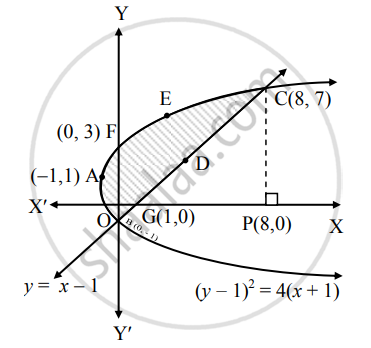
Required area = area of the region BFAB + area of the region OGDCEFO + area of the region OBGO
Now, area of the region BFAB
= area under the parabola (y − 1)2 = 4(x + 1),
Y-axis from y = −1 to y = 3
= `int_(-1)^3 x "d"y`
= `int_(-1)^3[(y - 1)^2/4 - 1] "d"y` ......[Form (i)]
= `[1/4*(y - 1)^3/3 - y]_(-1)^3`
= `[1/12 (3 - 1)^3 - 3] - [1/12(-1 - 1)^3 − (-1)]`
= `8/13 - 3 + 8/12 - 1`
= `4/3 - 4`
= `-8/3`
= `8/3` .......[∵ area cannot be negative]
Area of the region OGDCEFO = area of the region OPCEFO − area of the region GPCDG
= `int_0^8 y "d"x - int_1^8 y "d"x`
= `int_0^8 (2sqrt(x + 1) + 1) "d"x - int_1^8(x -1) "d"x` ......[From (i) and (ii)]
= `[2*((x + 1)^(3/2))/(3/2) + x]_0^8 - [x^2/2 - x]_1^8`
= `[4/(9)^(3/2) + 8 - 4/3(1)^(3/2) - 0] - [(64/2 - 8) - (1/2 - 1)]`
= `(36 + 8 - 4/3) - (24 + 1/2)`
= `44 - 4/3 - 24 - 1/2`
= `20 - (4/3 + 1/2)`
= `20 - 11/6`
= `109/6`
Area of the region OBGO = `int_0^1 y "d"x`
= `int_0^1(x - 1) "d"x` ......[From (ii)]
= `[x^2/2 - x]_0^1`
= `1/2 - 1 - 0`
= `1/2` ......[∵ area cannot be negative]
∴ Required area = `8/3 + 109/6 + 1/2`
= `(16 + 109 + 3)/6`
= `64/3` sq.units
