Advertisements
Advertisements
Questions
Find the area of the quadrilateral whose vertices, taken in order, are (–4, –2), (–3, –5), (3, –2) and (2, 3).
Find the area of the quadrilaterals, the coordinates of whose vertices are (–4, –2), (–3, –5), (3, –2), (2, 3).
Advertisements
Solution
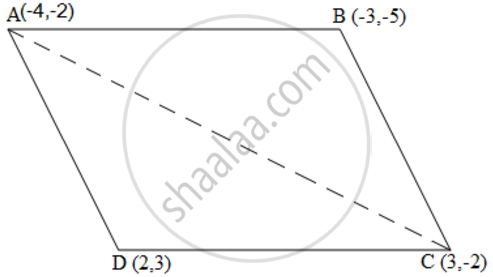
Let the vertices of the quadrilateral be A (-4, -2), B (-3, -5), C (3, -2), and D (2, 3). Join AC to form two triangles ΔABC and ΔACD.
Area of a triangle = `1/2 {x_1 (y_2 - y_3) + x_2 (y_3 - y_1) + x_3 (y_1 - y_2)}`
Area of ΔABC = `1/2 [(-4) {(-5) - (-2)} + (-3) {(-2) - (-2)} + 3 {(-2) - (-5)}]`
= `1/2 (12+0+9)`
= `21/2` square units
Area of ΔACD = `1/2 [(-4) {(-2) - (3)} + 3{(3) - (-2)} + 2 {(-2) - (-2)}]`
= `1/2 (20+15+0)`
= `35/2` square units
Area of ☐ABCD = Area of ΔABC + Area of ΔACD
=`(21/2 + 35/2)` square units = 28 square units
