Advertisements
Advertisements
Question
Find the area of the quadrilateral whose vertices are A(–3, 1), B(–2, –2), C(4, 1), D(2, 3).
Advertisements
Solution
A(–3, 1), B(–2, –2), C(4, 1), D(2, 3)
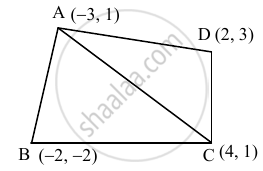
A(`square`ABCD) = A(ΔABC) + A(ΔACD)
Area of triangle = `1/2|(x_1, y_1, 1),(x_2, y_2, 1),(x_3, y_3, 1)|`
A(ΔABC) = `1/2|(-3, 1, 1),(-2, -2, 1),(4, 1, 1)|`
= `1/2[-3(-2 - 1) - 1(-2 - 4) + 1(-2 + 8)]`
= `1/2(9 + 6 + 6)`
∴ A(ΔABC) = `21/2` sq. units'.
∴ A(ΔACD) = `1/2|(-3, 1, 1),(4, 1, 1),(2, 3, 1)|`
= `1/2[-3(1 - 3) - 1(4 - 2) + 1(12 - 2)]`
= `1/2(6 - 2 + 10)`
∴ A(ΔACD) = 7 sq. units
∴ A(`square`ABCD) = A(ΔABC) + A(ΔACD)
= `21/2 + 7`
= `35/2` sq. units.
APPEARS IN
RELATED QUESTIONS
Find the area of the triangle whose vertices are: (4, 5), (0, 7), (–1, 1)
Find the area of triangles whose vertices are A(−1, 2), B(2, 4), C(0, 0).
Find the area of triangles whose vertices are P(3, 6), Q(−1, 3), R(2, −1)
Find the value of k, if area of ΔLMN is `33/2` square units and vertices are L(3, − 5), M(− 2, k), N(1, 4).
The maximum area of a right angled triangle with hypotenuse h is:
Find the values of 'K' if area of triangle is 4 square units and vertices are (k, 0), (4, 0), (0, 2).
If Δ = `|(1, 2, 3),(2, -1, 0),(3, 4, 5)|`, then `|(1, 6, 3),(4, -6, 0),(3, 12, 5)|` is
Find the area of triangle whose vertices are A ( -1,2), B (2,4), C (0,0)
Find the area of triangle whose vertices are A ( -1,2) ,B (2,4) ,C (0,0)
Find the area of triangle whose vertices are A(-1,2), B(2,4), C(0,0)
Find the area of triangle whose vertices are A( -1, 2), B(2, 4), C(0, 0).
Find the area of triangle whose vertices are A(-1, 2), B(2, 4), C(0, 0).
Find the area of triangle whose vertice are A(-1, 2), B(2, 4), C(0, 0)
Find the area of triangle whose vertices are A(-1, 2), B(2, 4), C(0, 0)
Find the area of triangle whose vertices are A(-1, 2), B(2, 4), C(0, 0).
Find the area of triangle whose vertices are A(−1, 2), B(2, 4), C(0, 0)
