Advertisements
Advertisements
प्रश्न
Find the area of the quadrilateral whose vertices are A(–3, 1), B(–2, –2), C(4, 1), D(2, 3).
योग
Advertisements
उत्तर
A(–3, 1), B(–2, –2), C(4, 1), D(2, 3)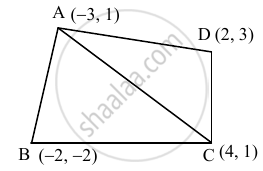
A(`square`ABCD) = A(ΔABC) + A(ΔACD)
Area of triangle = `1/2|(x_1, y_1, 1),(x_2, y_2, 1),(x_3, y_3, 1)|`
A(ΔABC) = `1/2|(-3, 1, 1),(-2, -2, 1),(4, 1, 1)|`
= `1/2[-3(-2 - 1) - 1(-2 - 4) + 1(-2 + 8)]`
= `1/2(9 + 6 + 6)`
∴ A(ΔABC) = `21/2` sq. units'.
∴ A(ΔACD) = `1/2|(-3, 1, 1),(4, 1, 1),(2, 3, 1)|`
= `1/2[-3(1 - 3) - 1(4 - 2) + 1(12 - 2)]`
= `1/2(6 - 2 + 10)`
∴ A(ΔACD) = 7 sq. units
∴ A(`square`ABCD) = A(ΔABC) + A(ΔACD)
= `21/2 + 7`
= `35/2` sq. units.
shaalaa.com
क्या इस प्रश्न या उत्तर में कोई त्रुटि है?
