Advertisements
Advertisements
Question
Find the area of the circle, length of whose circumference is equal to the sum of the lengths of the circumferences with radii 15 cm and 13 cm.
Advertisements
Solution
In a circle
Circumference = Sum of circumferences of two circle of radii 15 cm and 13 cm
Now circumference of first smaller circle = 2πr
= `2 xx 22/7 xx 15 = 660/7` cm
Circumference of the second smaller circle
= `2 xx 22/7 xx 13 = 572/7` cm
∴ Circumference of the bigger circle
= `660/7 + 572/7 = 1232/7` cm
Let R be its radius, then
`2pi"R" = 1232/7 ⇒ (2 xx 22)/7 "R" = 1232/7`
⇒ R = `1232/7 xx 7/44 = 28` cm
∴ Area of the circle = `pi"R"^2`
= `22/7 xx 28 xx 28 "cm"^2 = 2464` cm2
APPEARS IN
RELATED QUESTIONS
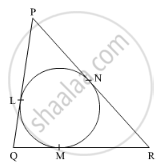
In Figure 5, a circle is inscribed in a triangle PQR with PQ = 10 cm, QR = 8 cm and PR =12 cm. Find the lengths of QM, RN and PL ?
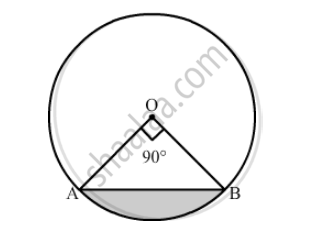
A square of diagonal 8 cm is inscribed in a circle. Find the area of the region lying outside the circle and inside the square.
In the following figure, the shaded area is
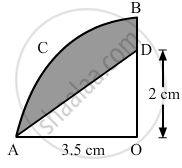
In the given figure, OABC is a quadrant of a circle with centre O and radius 3.5 cm. If OD = 2 cm, find the area of the shaded region.
The cost of fencing a circular field at the rate of Rs 25 per metre is Rs 5500. The field is to be ploughed at the rate of 50 paise per m2. Find the cost of ploughing the field. [Take `π = 22/7`].
Find the area of a ring whose outer and inner radii are respectively 23 cm and 12 cm.
If the sum of the areas of two circles with radii R1 and R2 is equal to the area of a circle of radius R, then ______.
A piece of wire of length 108 cm is bent to form a semicircular arc bounded by its diameter. Find its radius and area enclosed.
The sum of diameters of two circles is 112cm and the sum of their areas is 5236cm2. Find the radii of the two circles.
If the radii of two circles are in the ratio of 4 : 3, then their areas are in the ratio of ______.
