Advertisements
Advertisements
Question
Find the ratio which the line segment joining the pints A(3, -3) and B(-2,7) is divided by x -axis Also, find the point of division.
Advertisements
Solution
The line segment joining the points A(3, -3) and B(-2,7) is divided by x-axis. Let the required ratio be k : 1 So ,
` 0= (k (7) -3)/(k+1) ⇒ k =3/7`
Now,
`"Point of division" = ((k(-2)+3)/(k+1 \) , (k(7)-3)/(k+1))`
`=((3/7 xx(-2)+3)/(3/7+1) , (3/7xx (7) -3)/(3/7 +1)) (∵ k = 3/7)`
`= ((-6+21)/(3+7), (21-21)/(3+7))`
`=(3/2,0)`
`"Hence, the required ratio is 3:7and the point of division is"(3/2, 0)`
APPEARS IN
RELATED QUESTIONS
A line intersects the y-axis and x-axis at the points P and Q respectively. If (2, –5) is the mid-point of PQ, then find the coordinates of P and Q.
Let ABCD be a square of side 2a. Find the coordinates of the vertices of this square when The centre of the square is at the origin and coordinate axes are parallel to the sides AB and AD respectively.
Find the centre of the circle passing through (5, -8), (2, -9) and (2, 1).
In Fig. 14.36, a right triangle BOA is given C is the mid-point of the hypotenuse AB. Show that it is equidistant from the vertices O, A and B.
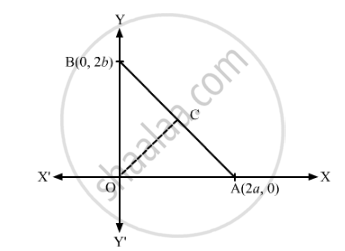
We have a right angled triangle,`triangle BOA` right angled at O. Co-ordinates are B (0,2b); A (2a, 0) and C (0, 0).
Find the value of x such that PQ = QR where the coordinates of P, Q and R are (6, -1), (1, 3) and (x, 8) respectively.
Find the coordinates of the point which divides the line segment joining (−1,3) and (4, −7) internally in the ratio 3 : 4
In what ratio does the point (−4, 6) divide the line segment joining the points A(−6, 10) and B(3,−8)?
Show hat A(1,2), B(4,3),C(6,6) and D(3,5) are the vertices of a parallelogram. Show that ABCD is not rectangle.
Find the coordinates of the midpoints of the line segment joining
A(3,0) and B(-5, 4)
Find the area of the triangle formed by joining the midpoints of the sides of the triangle whose vertices are A(2,1) B(4,3) and C(2,5)
Find the coordinates of the circumcentre of a triangle whose vertices are (–3, 1), (0, –2) and (1, 3).
If the point P(x, 3) is equidistant from the point A(7, −1) and B(6, 8), then find the value of x and find the distance AP.
If A(−3, 5), B(−2, −7), C(1, −8) and D(6, 3) are the vertices of a quadrilateral ABCD, find its area.
If A (5, 3), B (11, −5) and P (12, y) are the vertices of a right triangle right angled at P, then y=
The points (–5, 2) and (2, –5) lie in the ______.
If the perpendicular distance of a point P from the x-axis is 5 units and the foot of the perpendicular lies on the negative direction of x-axis, then the point P has ______.
Points (1, –1) and (–1, 1) lie in the same quadrant.
(–1, 7) is a point in the II quadrant.
In which ratio the y-axis divides the line segment joining the points (5, – 6) and (–1, – 4)?
Assertion (A): The ratio in which the line segment joining (2, -3) and (5, 6) internally divided by x-axis is 1:2.
Reason (R): as formula for the internal division is `((mx_2 + nx_1)/(m + n) , (my_2 + ny_1)/(m + n))`
