Advertisements
Advertisements
Question
Find out how the following game is played.
Badminton
Advertisements
Solution
It is played in singles, doubles, and mixed doubles. You have one player on each side of the court or two players on each side of the court. It is an indoor game. A badminton racquet and a shuttlecock are used to play the game. It is played on a rectangular court with a net in the centre. Players score points by striking the shuttlecock with their racquets so as to pass it to the opponents' half. If the shuttlecock falls, points are got.
RELATED QUESTIONS
Answer any four of the following in 30 − 40 words each :
(a) What does Saheb look for in the garbage dumps?
(b) How was Gandhi treated at Rajendra Prasad's house?
(c) Why does one feel 'a sudden strangeness' on counting to twelve and keeping quiet?
(d) Mention any two things which cause pain and suffering. (A Thing of Beauty)
(e) When was the Tiger King in danger of losing his throne?
(f) What role did the American professor play in bringing Hana and Sadao together?
Talk to your partner about the following.
Have you known someone like the author’s grandmother? Do you feel the same sense of loss with regard to someone whom you have loved and lost?
Stories can be told even in the form of poetry. Such poems are called Narrative poems. Narrative poems do not always follow rhythmic patterns of a fixed rhyme scheme. Such poems are written in a style called ‘Free Verse.’
Recall and name some narrative poems you have done/read earlier.
Using points from the lesson, give the details of the following in a short paragraph.
International Kite Festival at Ahmedabad.
Say where . . . . . . .
______ does Beauty’s smile begin?
Correct the following sentence using facts from the passage.
The great heroes avoided one another.
Choose a suitable heading for each announcement from those given below.
(Change in School Hours, Cleanliness, Story-telling Competition, Lost and Found, Warning, Football Match)
1.
|
6 July 2015 It has been observed by the Head Boy and Head Girl that certain classes do not clean up their classrooms before leaving. If any class is found untidy and littered after school, that class will be detained the next day after school hours up to 4 pm. Please take note of this. |
2.
| Tomorrow, that is, on the 10th of July, the school will close an hour earlier, as the teachers have to attend an important P. T. A. meeting. So please inform your parents to arrange to pick you up at 2 pm instead of 3 pm. |
3.
| On Sunday, 12th July 2015 there is a football match between classes VIII and IX, on the school ground. The match will begin at 9 am. All students are invited to come and cheer their favorite team. Please come on time, so that the players are not distracted. |
4.
|
The school has organized a Story-telling Competition for Classes V, VI, and VII from 21st to 25th of July. The competition will be held in the school hall at 10 in the morning. Children may select -
Three prizes will be given for each category. The time limit is 3-5 minutes. Those who wish to participate may contact Mrs. Sanjana Mohite for other details. They must register their names with her before the 16th of July. |
5.
|
Construction work to extend the school building will start next week. All students are cautioned not to cross over the fence at the construction site. It is dangerous and may cause you injury. Please stay away from that fence. |
6.
| A cycle key with a blue key chain has been found on the ground. Whoever has lost it can contact the clerk Mrs. Neena Pinto and see if it belongs to him/her. |
Identify the character or the speaker.
“Do not feel sad dear.”
Nithin had many ______toys.
The passage given below is on Kabbadi. Read the passage and complete the activities that follow.
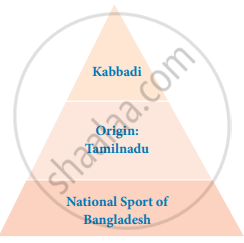
Kabbadi (கபடி - in Tamil) is a contact team sport that originated in Tamil Nadu, India. It is the national sport of Bangladesh. It is also popular in South Asia and is the state game of the Indian states of Tamil Nadu, Kerala, Andhra Pradesh, Bihar, Haryana, Karnataka, Maharashtra, Punjab, and Telangana.
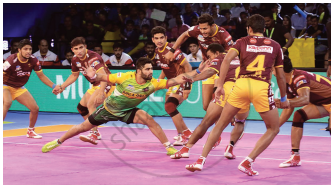
Kabbadi is played between two teams of seven players: the objective of the game is for a single player on offence referred to as a 'raider', to run in to the opposing teams half of a court, tag out as many of their defenders as possible, and return to their own half of the court–all without being tackled by the defenders. Points are scored for each player tagged by the raider, while the opposing team earns a point for stopping the raider. Players are taken out of the game if they are tagged or tackled, but can be 'revived' for each point scored by their team from a tag or tackle. The raider should hold his breath and utter the words like 'kabbadi kabbadi, hututu hututu, chadu kudu' etc. while the opponents try to catch him. If he stops uttering these words, he is considered out.
The game is known by its regional names in different parts of the subcontinent, such as Kabbadi or Chedugudu in Andhra Pradesh, Kabbadi in Kerala and Telangana, Hadudu in Bangladesh, Bhavatik in Maldives, Kauddi or Kabbadi in the Punjab Region, Hu-Tu-Tu in Western India and Hu-Do-Do in Eastern India and Chadakudu in South India. The highest governing body of Kabbadi is the International Kabbadi Federation.
Given below is the visual presentation of the first paragraph.
i) Represent the other paragraphs in a visual form of your choice(flow chart, mind-map, pie-chart, etc.).
ii) Choose the correct option.
1. A contact sport usually involves a ______contact between players.
- violent
- gentle
- physical
2. Kabbadi is a game played between ______.
- seven teams of two players
- two teams of seven players
- four teams of seven players
3. A single ______.
- player on offence is referred to as a raider
- offence is referred to as a raider
- raider is an offence by the player
iii) Answer the following.
- How does a raider score points for his team?
- When does a raider concede a point to the opponent team?
- Can a player be revived when he/she is out of the game? Explain your answer.
- Kabbadi is called by different names in different parts of India. Do you know how Pallankuzhi is called in Karnataka, Andhra Pradesh and Kerala?
