Find the Moment of Inertia of a Pair of Spheres, Each Having a Mass Mass M and Radius R, Kept in Contact About the Tangent Passing Through the Point of Contact.
Advertisements
Question
Find the moment of inertia of a pair of spheres, each having a mass mass m and radius r, kept in contact about the tangent passing through the point of contact.
Advertisements
Solution
It is given that two bodies of mass m and radius r are moving along a common tangent.
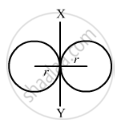
Moment of inertia of the first body about XY tangent,
\[I' = I_{com} + m r^2\]
\[\text{So, }I' = \frac{2}{5}m r^2 + m r^2 = \frac{7}{5}m r^2\]
Moment of inertia of the second body about XY tangent,
\[I'' = \frac{2}{5}m r^2 + m r^2 = \frac{7}{5}m r^2\]
Therefore, net moment of inertia,
\[I = I' + I''\]
\[I = \frac{7}{5}m r^2 + \frac{7}{5}m r^2\]
\[= \frac{14}{5}m r^2\text{ units}\]
APPEARS IN
RELATED QUESTIONS
A hollow sphere, a solid sphere, a disc and a ring all having same mass and radius are rolled down on an inclined plane. If no slipping takes place, which one will take the smallest time to cover a given length?
A closed cylindrical tube containing some water (not filling the entire tube) lies in a horizontal plane. If the tube is rotated about a perpendicular bisector, the moment of inertia of water about the axis __________ .
A cubical block of mass M and edge a slides down a rough inclined plane of inclination θ with a uniform velocity. The torque of the normal force on the block about its centre has a magnitude
A thin circular ring of mass M and radius r is rotating about its axis with an angular speed ω. Two particles having mass m each are now attached at diametrically opposite points. The angular speed of the ring will become
A wheel of radius 20 cm is pushed to move it on a rough horizontal surface. If is found to move through a distance of 60 cm on the road during the time it completes one revolution about the centre. Assume that the linear and the angular accelerations are uniform. The frictional force acting on the wheel by the surface is ______________________ .
A solid sphere, a hollow sphere and a disc, all having same mass and radius, are placed at the top on an incline and released. The friction coefficients between the objects and the incline are same and not sufficient to allow pure rolling. Least time will be taken in reaching the bottom by ___________ .
In the previous question, the smallest kinetic energy at
the bottom of the incline will be achieved by ___________ .
A string of negligible thickness is wrapped several times around a cylinder kept on a rough horizontal surface. A man standing at a distance l from the cylinder holds one end of the string and pulls the cylinder towards him (see the following figure). There is no slipping anywhere. The length of the string passed through the hand of the man while the cylinder reaches his hands is _________ .
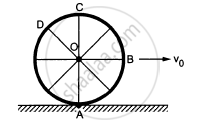
Consider a wheel of a bicycle rolling on a level road at a linear speed \[\nu_0\] (see the following figure)
(a) the speed of the particle A is zero
(b) the speed of B, C and D are all equal to \[v_0\]
(c) the speed of C is 2 \[v_0\]
(d) the speed of B is greater than the speed of O.
Three particles, each of mass 200 g, are kept at the corners of an equilateral triangle of side 10 cm. Find the moment of inertial of the system about an axis joining two of the particles.
Three particles, each of mass 200 g, are kept at the corners of an equilateral triangle of side 10 cm. Find the moment of inertial of the system about an axis passing through one of the particles and perpendicular to the plane of the particles.
The surface density (mass/area) of a circular disc of radius a depends on the distance from the centre as [rholeft( r right) = A + Br.] Find its moment of inertia about the line perpendicular to the plane of the disc thorough its centre.
A metre stick weighing 240 g is pivoted at its upper end in such a way that it can freely rotate in a vertical place through this end (see the following figure). A particle of mass 100 g is attached to the upper end of the stick through a light string of length 1 m. Initially, the rod is kept vertical and the string horizontal when the system is released from rest. The particle collides with the lower end of the stick and sticks there. Find the maximum angle through which the stick will rise.
A sphere of mass m rolls on a plane surface. Find its kinetic energy at an instant when its centre moves with speed \[\nu.\]
