Advertisements
Advertisements
Question
Find if the following points are collinear or not by using a graph:
(i) (-2, -1), (0, 3) and (1, 5)
(ii) (1, 3), (-2, -4) and (3, 5)
(iii) (2, -1), (2, 5) and (2, 7)
(iv) (4, -1), (-5, -1) and (3, -1)
Advertisements
Solution
(i) (-2, -1), (0, 3) and (1, 5)
(-2, -1), (0, 3) and (1, 5) are collinear points.
(ii) (1, 3), (-2, -4) and (3, 5)
(1, 3), (-2, -4) and (3, 5) are not collinear points.
(iii) (2, -1), (2, 5) and (2, 7)
(2, -1), (2, 5) and (2, 7) are collinear points.
(iv) (4, -1), (-5, -1) and (3, -1)
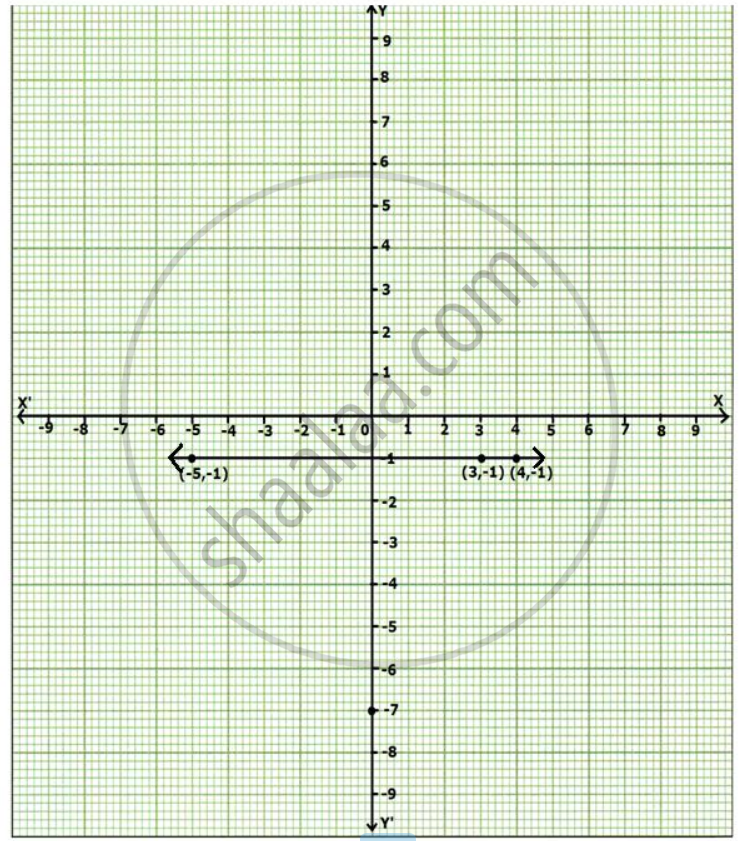
(4, -1), (-5, -1) and (3, -1) are collinear points.
APPEARS IN
RELATED QUESTIONS
Draw the graph for the linear equation given below:
x + 3 = 0
Draw the graph for the linear equation given below:
y = - x + 4
Draw the graph for the each linear equation given below:
y = `(3x)/(2) + (2)/(3)`
Draw the graph for the linear equation given below:
x - 3 = `(2)/(5)(y + 1)`
Draw the graph for the equation given below:
2x - 5y = 10
Draw the graph for the equation given below:
`(1)/(2) x + (2)/(3) y = 5`.
On the same graph paper, plot the graphs of y = 2x - 1, y = 2x and y = 2x + 1 from x = - 2 to x = 4. Are the graphs (lines) drawn parallel to each other?
Draw the graph of equation `x/(4) + y/(5) = 1` Use the graph drawn to find:
(i) x1, the value of x, when y = 10
(ii) y1, the value of y, when x = 8.
Use the graphical method to show that the straight lines given by the equations x + y = 2, x - 2y = 5 and `x/(3) + y = 0` pass through the same point.
Draw a graph of each of the following equations: x + y - 3 = 0
