Advertisements
Advertisements
Question
Find the equations of the planes that passes through three points.
(1, 1, 0), (1, 2, 1), (−2, 2, −1)
Advertisements
Solution
The given points are A (1, 1, 0), B (1, 2, 1), and C (−2, 2, −1).
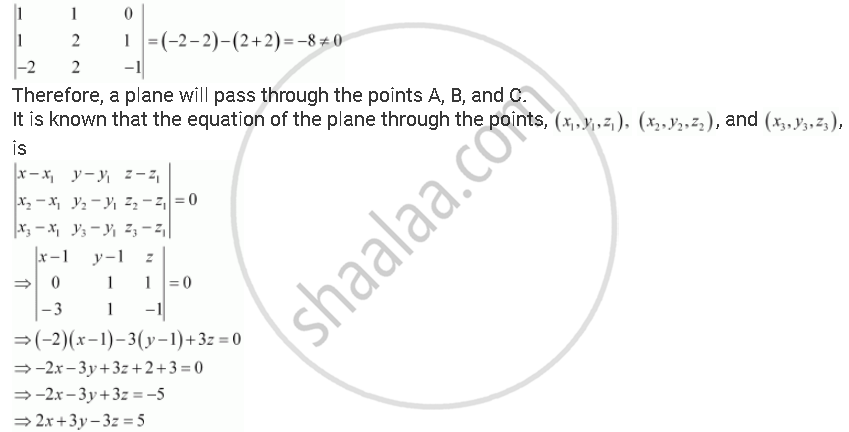
This is the Cartesian equation of the required plane.
APPEARS IN
RELATED QUESTIONS
Find the equation of the plane passing through the point (−1, 3, 2) and perpendicular to each of the planes x + 2y + 3z = 5 and 3x + 3y + z = 0.
Find the Cartesian form of the equation of a plane whose vector equation is
\[\vec{r} \cdot \left( 12 \hat{i} - 3 \hat{j} + 4 \hat{k} \right) + 5 = 0\]
Find the Cartesian form of the equation of a plane whose vector equation is
\[\vec{r} \cdot \left( - \hat{i} + \hat{j} + 2 \hat{k} \right) = 9\]
Find the vector equation of each one of following planes.
x + y − z = 5
Show that the normals to the following pairs of planes are perpendicular to each other.
x − y + z − 2 = 0 and 3x + 2y − z + 4 = 0
Show that the normals to the following pairs of planes are perpendicular to each other.
Find the vector equation of a plane which is at a distance of 3 units from the origin and has \[\hat{k}\] as the unit vector normal to it.
Find the vector equation of the plane passing through points A (a, 0, 0), B (0, b, 0) and C(0, 0, c). Reduce it to normal form. If plane ABC is at a distance p from the origin, prove that \[\frac{1}{p^2} = \frac{1}{a^2} + \frac{1}{b^2} + \frac{1}{c^2} .\]
Find the vector equation of the plane passing through the points \[3 \hat{i} + 4 \hat{j} + 2 \hat{k} , 2 \hat{i} - 2 \hat{j} - \hat{k} \text{ and } 7 \hat{i} + 6 \hat{k} .\]
Determine the value of λ for which the following planes are perpendicular to each other.
3x − 6y − 2z = 7 and 2x + y − λz = 5
Find the equation of a plane passing through the point (−1, −1, 2) and perpendicular to the planes 3x + 2y − 3z = 1 and 5x − 4y + z = 5.
Obtain the equation of the plane passing through the point (1, −3, −2) and perpendicular to the planes x + 2y + 2z = 5 and 3x + 3y + 2z = 8.
Find the equation of the plane passing through the points (2, 2, 1) and (9, 3, 6) and perpendicular to the plane 2x + 6y + 6z = 1.
Find the equation of the plane passing through the points whose coordinates are (−1, 1, 1) and (1, −1, 1) and perpendicular to the plane x + 2y + 2z = 5.
Find the vector equation of the plane through the points (2, 1, −1) and (−1, 3, 4) and perpendicular to the plane x − 2y + 4z = 10
Find the equation of the plane through (2, 3, −4) and (1, −1, 3) and parallel to x-axis.
Find the vector equation of the line passing through (1, 2, 3) and perpendicular to the plane \[\vec{r} \cdot \left( \hat{i} + 2 \hat{j} - 5 \hat{k} \right) + 9 = 0 .\]
Find the equation of a plane which passes through the point (3, 2, 0) and contains the line \[\frac{x - 3}{1} = \frac{y - 6}{5} = \frac{z - 4}{4}\] .
Find the equation of the plane that contains the point (1, –1, 2) and is perpendicular to both the planes 2x + 3y – 2z = 5 and x + 2y – 3z = 8. Hence, find the distance of point P (–2, 5, 5) from the plane obtained
Find the position vector of the foot of perpendicular and the perpendicular distance from the point P with position vector \[2 \hat{i} + 3 \hat{j} + 4 \hat{k} \] to the plane \[\vec{r} . \left( 2 \hat{i} + \hat{j} + 3 \hat{k} \right) - 26 = 0\] Also find image of P in the plane.
Write the intercepts made by the plane 2x − 3y + 4z = 12 on the coordinate axes.
Write the ratio in which the plane 4x + 5y − 3z = 8 divides the line segment joining the points (−2, 1, 5) and (3, 3, 2).
Write the distance between the parallel planes 2x − y + 3z = 4 and 2x − y + 3z = 18.
Write the equation of the plane \[\vec{r} = \vec{a} + \lambda \vec{b} + \mu \vec{c}\] in scalar product form.
Write the intercept cut off by the plane 2x + y − z = 5 on x-axis.
If O be the origin and the coordinates of P be (1, 2,−3), then find the equation of the plane passing through P and perpendicular to OP.
Find the image of the point (1, 6, 3) in the line `x/1 = (y - 1)/2 = (z - 2)/3`.
Find the equation of a plane which bisects perpendicularly the line joining the points A(2, 3, 4) and B(4, 5, 8) at right angles.
Find the length and the foot of perpendicular from the point `(1, 3/2, 2)` to the plane 2x – 2y + 4z + 5 = 0.
Find the equations of the line passing through the point (3, 0, 1) and parallel to the planes x + 2y = 0 and 3y – z = 0.
The equation of a line, which is parallel to `2hat"i" + hat"j" + 3hat"k"` and which passes through the point (5, –2, 4), is `(x - 5)/2 = (y + 2)/(-1) = (z - 4)/3`.
If the foot of perpendicular drawn from the origin to a plane is (5, – 3, – 2), then the equation of plane is `vec"r".(5hat"i" - 3hat"j" - 2hat"k")` = 38.
The point at which the normal to the curve y = `"x" + 1/"x", "x" > 0` is perpendicular to the line 3x – 4y – 7 = 0 is:
