English

Find the equation of the normal at a point on the curve x2 = 4y which passes through the point (1, 2). Also find the equation of the corresponding tangent. - Mathematics

Advertisements
Advertisements

Question

Find the equation of the normal at a point on the curve x2 = 4y which passes through the point (1, 2). Also find the equation of the corresponding tangent.

Advertisements

Solution

Equations of the given circles are

`x^2+y^2=4 ................(1)`

`(x-2)^2+y^2=4...........(2)`

Equation (1) is a circle with centre O at the origin and radius 2. Equation (2) is a circle with centre C (2, 0) and radius 2. Solving equations (1) and (2), we have

`(x-2)^2+y^2=x^2+y^2`

`or x^2-4x+4+y^2=x^2+y^2`

or x=1 which gives `y=+-sqrt3`

Thus, the points of intersection of the given circles are `A(1,sqrt3) and A'(1,-sqrt3) ` as shown in the Figure
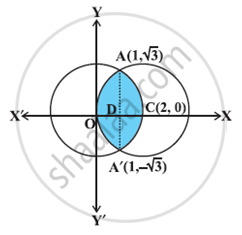
Required area of the enclosed region OACA′O between circles

= 2 [area of the region ODCAO]

= 2 [area of the region ODAO + area of the region DCAD]

`=2[int_0^1ydx+int_1^2ydx]`

`=2[int_0^1sqrt(4-(x-2)^2)dx+int_1^2sqrt(4-x^2)dx]`

`=2[1/2(x-2)sqrt(4-(x-2)^2)+1/2xx4sin^(-1)((x-2)/2)]_0^1+2[1/2xsqrt(4-x^2)+1/2xx4sin^(-1)(x/2)]_1^2`

`=[(x-2)sqrt(4-(x-2)^2)+4sin^(-1)((x-2)2)]_0^1+[xsqrt(4-x^2)+4sin^(-1)(x/2)]_1^2`

`=[(-sqrt3+4sin^(-1)(-1/2))-4sin^(-1)(-1)]+[4sin^(-1)1-sqrt3-4sin^(-1)(1/2)]`

`=[(-sqrt3-4xxpi/6)+4xxpi/2]+[4xxpi/2-sqrt3-4xxpi/6]`

`=(8pi)/3-2sqrt3`


shaalaa.com
  Is there an error in this question or solution?
2012-2013 (March) Delhi Set 1

RELATED QUESTIONS

Find the equations of the tangent and normal to the curve x = a sin3θ and y = a cos3θ at θ=π/4.


Find the slope of the tangent to the curve y = x3 − 3x + 2 at the point whose x-coordinate is 3.


Find points at which the tangent to the curve y = x3 − 3x2 − 9x + 7 is parallel to the x-axis.


Find the equation of the normal to curve y2 = 4x at the point (1, 2).


Find the slope of the tangent and the normal to the following curve at the indicted point y = 2x2 + 3 sin x at x = 0 ?


Find the slope of the tangent and the normal to the following curve at the indicted point x = a (θ − sin θ), y = a(1 − cos θ) at θ = −π/2 ?


Find the slope of the tangent and the normal to the following curve at the indicted point  x = a (θ − sin θ), y = a(1 − cos θ) at θ = π/2 ?


Find a point on the curve y = x3 − 3x where the tangent is parallel to the chord joining (1, −2) and (2, 2) ?


Find the points on the curve xy + 4 = 0 at which the tangents are inclined at an angle of 45° with the x-axis ?


Find the points on the curve \[\frac{x^2}{4} + \frac{y^2}{25} = 1\] at which the tangent is parallel to the x-axis ?


Find the equation of the normal to the curve x2 + 2y2 − 4x − 6y + 8 = 0 at the point whose abscissa is 2 ?


Find the equation of the tangent line to the curve y = x2 + 4x − 16 which is parallel to the line 3x − y + 1 = 0 ?


Find the angle of intersection of the following curve y2 = x and x2 = y  ?


Write the coordinates of the point on the curve y2 = x where the tangent line makes an angle \[\frac{\pi}{4}\] with x-axis  ?


The slope of the tangent to the curve x = 3t2 + 1, y = t3 −1 at x = 1 is ___________ .


The curves y = aex and y = be−x cut orthogonally, if ___________ .


The point on the curve y2 = x, where the tangent makes an angle of `pi/4` with x-axis is ______.


Prove that the curves xy = 4 and x2 + y2 = 8 touch each other.


The tangent to the curve y = e2x at the point (0, 1) meets x-axis at ______.


At (0, 0) the curve y = x3 + x


The slope of the tangent to the curve x = a sin t, y = a{cot t + log(tan `"t"/2`)} at the point ‘t’ is ____________.


Tangents to the curve x2 + y2 = 2 at the points (1, 1) and (-1, 1) are ____________.


Which of the following represent the slope of normal?


The number of values of c such that the straight line 3x + 4y = c touches the curve `x^4/2` = x + y is ______.


The curve `(x/a)^n + (y/b)^n` = 2, touches the line `x/a + y/b` = 2 at the point (a, b) for n is equal to ______.


If the tangent to the conic, y – 6 = x2 at (2, 10) touches the circle, x2 + y2 + 8x – 2y = k (for some fixed k) at a point (α, β); then (α, β) is ______.


Share
Notifications

Englishहिंदीमराठी


      Forgot password?
Use app×