Advertisements
Advertisements
Question
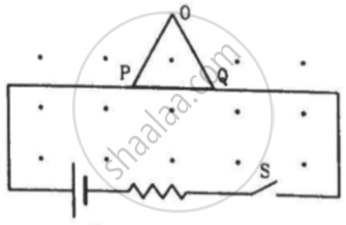
Figure shows a rod PQ of length 20.0 cm and mass 200 g suspended through a fixed point O by two threads of lengths 20.0 cm each. A magnetic field of strength 0.500 T exists in the vicinity of the wire PQ, as shown in the figure. The wires connecting PQ with the battery are loose and exert no force on PQ. (a) Find the tension in the threads when the switch S is open. (b) A current of 2.0 A is established when the switch S is closed. Find the tension in the threads now.
Advertisements
Solution
Given:
Length of the rod PQ = 20.0 cm
Mass of the rod, M = 200 g
Length of the two threads, l = 20.0 cm
Applied magnetic field, B = 0.500 T
As per the question,
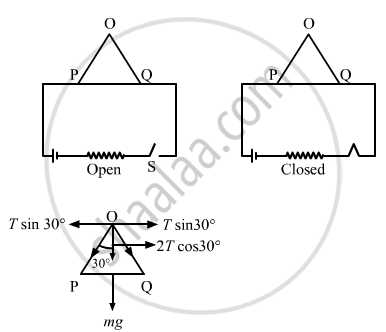
(a) When the circuit is open:
The weight of the rod is balanced by the tension in the rod. So,
2Tcos30° = Mg
`T = (mg)/(2cos30^circ)`
=`(0.2xx9.8)/(2 (sqrt(3)/2)`
=1.13 N
(b) When the circuit is closed and current flowing through the circuit = 2 A:
Then,
2Tcos 30°= Mg + ilB
= 0.200× 9.8 + 2 × 0.2 × 0.5
= 1.95 + 0.2 = 2.16
⇒ `2T = 2.16xx (2)/(sqrt(3)`
⇒ T = 1.245 = 1.25 N
APPEARS IN
RELATED QUESTIONS
Draw a neat labelled diagram for the construction of 'cyclotron'
Which one of the following particles cannot be accelerated by a cyclotron?
(A) Electrons
(B) Protons
(C) Deuterons
(D) α- particles
Show that the time period of revolution of particles in a cyclotron is independent of their speeds. Why is this property necessary for the operation of a cyclotron?
State the underlying principle of a cyclotron. Write briefly how this machine is used to accelerate charged particles to high energies
If a watch-glass containing a small quantity of water is placed on two dissimilar magnetic poles, then water ______.
Obtain the expression for the cyclotron frequency.
A proton and an electron travelling along parallel paths enter a region of uniform magnetic field, acting perpendicular to their paths. Which of them will move in a circular path with higher frequency?
Explain the principle and working of a cyclotron with the help of a schematic diagram. Write the expression for cyclotron frequency.
An electron is projected horizontally with a kinetic energy of 10 keV. A magnetic field of strength 1.0 × 10⁻⁷ T exists in the vertically upward direction.
(a) Will the electron deflect towards the right or left of its motion?
(b) Calculate the sideways deflection of the electron while travelling through 1 m. Make appropriate approximations.
Consider a 10-cm long portion of a straight wire carrying a current of 10 A placed in a magnetic field of 0.1 T making an angle of 53° with the wire. What magnetic force does the wire experience?
A conducting wire of length l, lying normal to a magnetic field B, moves with a velocity v,as shown in the figure. (a) Find the average magnetic force on a free electron of the wire. (b) Due to this magnetic force, electrons concentrate at one end, resulting in an electric field inside the wire. The redistribution stops when the electric force on the free electrons balances the magnetic force. Find the electric field developed inside the wire when the redistribution stops. (c) What potential difference is developed between the ends of the wire?

Cyclotron frequency of a charged particle having charge q and mass m in a cyclotron producing magnetic field B is ______.
Assertion: The frequency of circular motion of a charged particle in cyclotron is independent of the mass of the particle.
Reason: Greater the mass of the particle less will be the frequency of the particle.
Which of the following is not correct about cyclotron?
An aircraft executes a horizontal loop of radius 1.00 km with a steady speed of 900 km/h. Its centripetal acceleration is ______.
A cyclotron can accelerate ______.
In a cyclotron, a charged particle ______.
