Advertisements
Advertisements
Question
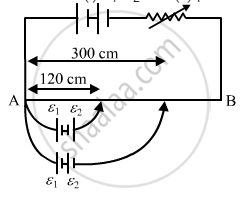
Figure shows a long potentiometer wire AB having a constant potential gradient. The null points for the two primary cells of emfs ε1 and ε2 connected in the manner shown are obtained at a distance of l1 = 120 cm and l2 = 300 cm from the end A. Determine (i) ε1/ε2 and (ii) position of null point for the cell ε1 only.
Advertisements
Solution
(i) Let x be the resistance per unit length of the potentiometer wire and I be the constant current flowing through it. Then from the figure, we have:
\[\frac{\epsilon_1 - \epsilon_2}{\epsilon_1 + \epsilon_2} = \frac{120}{300}\]
\[ \Rightarrow 180 \epsilon_1 = 420 \epsilon_2 \]
\[ \Rightarrow \frac{\epsilon_1}{\epsilon_2} = \frac{7}{3}\]
(ii) Now adding equations (1) and (2), we get:
\[2 \epsilon_1 = \left( 420x \right)I\]
\[ \Rightarrow \epsilon_1 = \left( 210x \right)I\]
Comparing with
\[\epsilon = \left( Lx \right)I\]we get:
length of balancing point, L = 210 cm for cell 1
RELATED QUESTIONS
SI unit of potential gradient is _______.
(a) V cm
(b) `V/"cm"`
(c) Vm
(d) `V/m`
A student uses the circuit diagram of a potentiometer as shown in the figure
(a) for a steady current I passing through the potentiometer wire, he gets a null point for the cell ε1. and not for ε2. Give the reason for this observation and suggest how this difficulty can be resolved.
(b) What is the function of resistance R used in the circuit? How will the change in its value affect the null point?
(c) How can the sensitivity of the potentiometer be increased?

When the null point is obtained in the potentiometer, the current is drawn from the ______
The instrument which can measure terminal potential difference as well as electromotive force (emf) is ______
What is the SI unit of potential gradient?
A potentiometer is an accurate and versatile device to make electrical measurements of E.M.F. because the method involves ______.
The best instrument for accurate measurement of EMF of a cell is ____________.
What is the current I in the circuit as show in fig.

What is the internal resistance of the cell?
