Advertisements
Advertisements
Question
Figure 6 below shows a long straight conductor X carrying a current I1. A point P is at a perpendicular distance ‘r1’ from it.
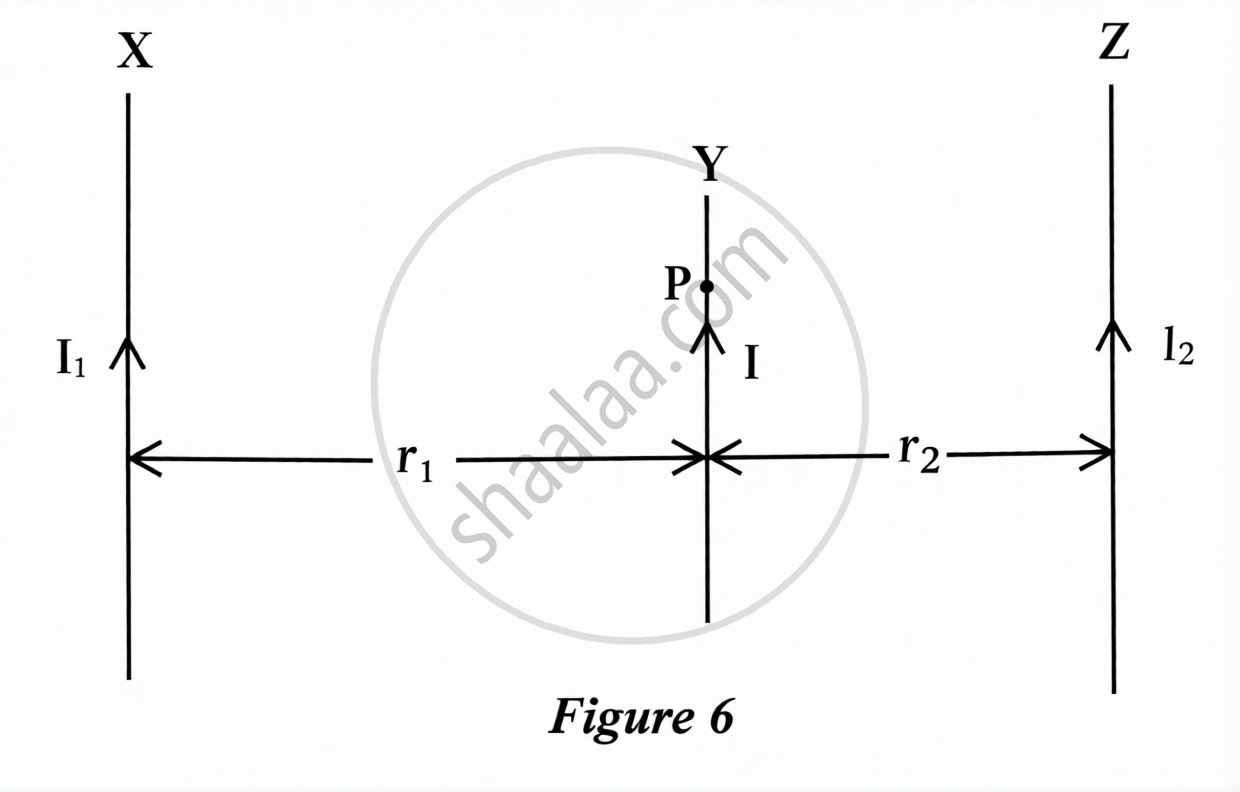
- How much force conductor X exerts on a short conductor Y of length ‘l’ which is carrying a current ‘I’ and is kept at point P parallel to the conductor X?
- Another long wire Z carrying a current I2 is now kept parallel to X and Y at a distance ‘r2’ from Y such that the conductor Y remains at rest. Obtain the relation between the currents I1 and I2.
Advertisements
Solution
(i) Force exerted by conductor X on conductor Y
The magnetic field B1 produced by a long straight conductor X carrying current I1 at a perpendicular distance r1 is given by:
`B_1 = (mu_0 I_1)/(2pir_1)`
The force Fx acting on conductor Y(of length l and current I) placed in this magnetic field is:
FX = B1Il sin(θ)
Since the conductors are parallel, the magnetic field is perpendicular to conductor Y(θ = 90°, so sin 90° = 1). Substituting the value of B1.
`F_X = (mu_0I_1Il)/(2pir_1)`
Since both currents I1 and I are in the same direction (upwards), the force is attractive, meaning conductor Y is pulled towards conductor X.
(ii) Relation between currents I1 and I2 for equilibrium
For conductor Y to remain at rest, the net force on it must be zero. This means the force exerted by conductor Z (FZ) must be equal in magnitude and opposite in direction to FX.
Force from Z: Similar to FX, the force exerted by conductor Z on Y at distance r2 is:
`F_Z = (mu_0I_2Il)/(2pir_2)`
Since I1 and I2 are in the same direction, this force is also attractive, pulling Y towards Z (to the right).
Equilibrium Condition: FX = FZ
`(mu_0I_1Il)/(2pir_1) = (mu_0I_2Il)/(2pir_2)`
`(I_1)/(r_1) = (I_2)/(r_2)`
I1r2 = I2r1
or `(I_1)/(I_2) = (r_1)/(r_2)`
