Advertisements
Advertisements
Question
Explain the working of a hydraulic brake with a simple labelled diagram.
Advertisements
Solution

Working: To apply brakes, the foot pedal is pressed due to which pressure is exerted on the liquid in the master cylinder P, so liquid runs out from the master cylinder P to the wheel cylinder Q. As a result, the pressure is transmitted equally and undiminished through the liquid to the pistons B1 and B2 of the wheel cylinder. Therefore, the pistons B1 and B2 get pushed outwards and brake shoes get pressed against the rim of the wheel due to which the motion of the vehicle retards. Due to transmission of pressure through the liquid, equal pressure is exerted on all the wheels of the vehicle connected to the pipe line R.
On releasing the pressure on the pedal, the liquid runs back from the wheel cylinder Q to the master cylinder P and the spring pulls the break shoes to their original position and forces the pistons B1 and B2 to return back into the wheel cylinder Q. Thus, the brakes get released.
APPEARS IN
RELATED QUESTIONS
Explain the principle of a hydraulic machine. Name two devices which work on this principle.
Name and state the principle on which a hydraulic press works. Write one use of hydraulic press.
In a hydraulic machine, a force of 2 N is applied on the piston of area of cross section 10 cm2. What force is obtained on its piston of area of cross section 100 cm2 ?
Select the correct option.
One Pascal is equal to
Select the correct option.
The pressure exerted by 50 kg (g = 10 m/s−2) on an area of cross-section of 2 m2 is
Select the correct option.
Pressure at a point inside a liquid does not depend on
Define the SI unit of pressure.
The density of iron is 7800 kg m-3. What do you mean by this statement? What is density of water at 40C?
Consider a water tank shown in the figure. It has one wall at x = L and can be taken to be very wide in the z direction. When filled with a liquid of surface tension S and density ρ, the liquid surface makes angle θ(θ << 1) with the x-axis at x = L. If y(x) is the height of the surface then the equation for y(x) is:
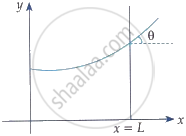
(take θ(x) = sin θ(x) = tan θ(x) = `dy/dx`, g is the acceleration due to gravity)
