Advertisements
Advertisements
Question
Explain the mode of infection and cause of elephantiasis.
Answer in Brief
Advertisements
Solution
Lymphatic filariasis, commonly known as elephantiasis, is a neglected tropical disease. Infection occurs when filarial parasites are transmitted to humans through mosquitoes. Infection is usually acquired in childhood causing hidden damage to the lymphatic system.
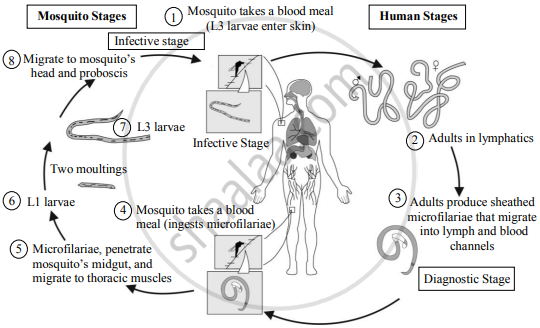
The life cycle of Wuchereria bancrofti:
- Wuchereria bancrofti has a complicated life cycle that consists of five stages.
- After mating of male and female worms, the female gives birth to thousands of live microfilariae.
- These microfilariae are taken up by vector insect (intermediate host), as a blood meal.
- In the intermediate host, microfilariae moult and develop into 3 rd stage (infective) larvae, in the intermediate host.
- When the vector bites a healthy person, infectious larvae are injected in the dermis of the skin.
- After about one year, the larvae moult through two more stages maturing into adult worms.
Mode of transmission:
Wuchereria bancrofti is transmitted to the human body by female Culex mosquito. The larvae escape the mosquito bodies and arrive on the human skin.
They penetrate the skin, undergo two moultings before they become adults, and settle in the lymphatic system. The incubation period can be as long as 8-16 months.
shaalaa.com
Is there an error in this question or solution?
