Advertisements
Advertisements
Question
Explain the importance of the Himalayas and the Indian Ocean with respect to the climate of India.
Advertisements
Solution 1
Importance of the Himalayas:
- The Himalayas act as a barrier protecting the great Plains of India from the cold winds of Central Asia during the severe winter season.
- The Himalayas are the reason for summer rains and a monsoon-type climate in the regions beyond the Western Ghats of India.
- Himalaya is responsible for the origin of perennial rivers, which bring a lot of silt, making the northern plains very fertile.
Importance of the Indian Ocean:
The Indian Ocean is one of the greatest oceans that brings more moisture, which is responsible for the very moderate climatic conditions in South India. The role of the Himalayas on Indian agriculture and climate is that it not only increases the fertility level of soil but also causes rainfall.
Solution 2
The Indian Ocean and the Himalayas play a major role in shaping India's monsoon and climate.
- The Himalayas protect India from bitterly cold winds that blow from the north. Thus, India does not experience severe cold during winter.
- At the beginning of summer, temperatures on the mainland rise. So, a low-pressure belt develops in the Punjab plains and the Thar desert of Rajasthan.
- At the same time, a high-pressure belt develops over the Indian Ocean. Therefore, the moisture-laden winds coming from the south-west begin to blow from the high-pressure area to the low-pressure area. These are south-west monsoon winds.
- India receives rainfall from the south-west monsoon winds. Due to the obstruction of the Western Ghats to the west, the western coast receives maximum rainfall from the south-west monsoon winds. It is approximately 400 to 500 cms.
- On the leeward side of the hills, the rainfall reduces. These winds blow parallel to the Aravalis. As they are not high enough to check the winds, parts of Rajasthan and Gujarat receive less rainfall.
- Later, these winds move towards the Himalayas, and orographic rainfall occurs due to the natural obstruction of the Himalayas.
- During winter, temperatures on the Indian subcontinent are lower than those on the Indian Ocean. Hence, winds start blowing from the north-east. These are dry winds, but as they move towards the Indian Ocean, they retain moisture. These north-east monsoon winds bring rainfall to the eastern coast and to some parts of the Peninsula.
In this way, the Himalayas and the Indian Ocean play a very important role in India's climate.
Notes
Students should refer to the answer according to their preferred marks.
APPEARS IN
RELATED QUESTIONS
Choose the right answer from the alternative given below.
Which one of the following causes rainfall during winters in north-western part of India?
Compare the climates of Brazil and India.
In the upper layers of the troposphere ______ are found.
The Himalayas act not only as physical barrier but also as ______.
Which regions of India still has natural vegetation in real sense?
Find out which songs, dances, festivals and special food preparations are associated with certain seasons in your region. Do they have some commonality with other regions of India?
Now think why Jodhpur has a hot desert type of climate?
In spite of these facts see carefully if there is strong evidence to conclude that the monsoons still provide a very strong framework lending overall climatic unity to the whole country.
Mark the following in the outline map of India supplied to you. Write the names. Give Index
- Sikkim
- Lakshadweep Island
- Chennai Port
- Mineral oil refineries in Assam-Digboi
- Any one southern state with high density of population
- Tropic of Cancer
Observe the following graph and answer the questions given below:
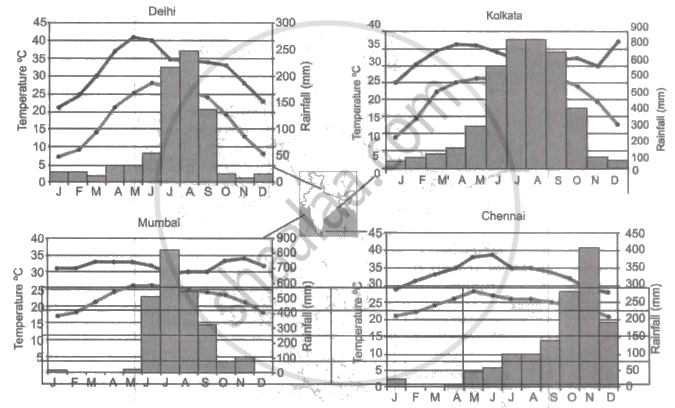
Note: In the graphs, the dark line represents the max. temperature and the lighter line represents min. temperature. The bars represent the amount of rainfall every month in each city.
- Where in the four cities is the rainfall heaviest?
- Which city has the most rainfall throughout the year?
- Which city experiences the highest temperature?
- Calculate the average range of minimum and maximum temperature for all four cities.
- What do the temperature curves in Delhi indicate?
- What is the condition of Mumbai during monsoons?
Why houses in Assam are built on stilts?
