Advertisements
Advertisements
Question
Explain the geometric method of calculating the elasticity of supply.
Advertisements
Solution 1
According to the geometric method, elasticity is measured at a given point on the supply curve.
This method is also known as the ‘Arc Method’ or ‘Point Method’.
- Highly Elastic Supply (Es > 1): A supply curve that passes through the Y-axis and meets the extended X-axis at some point. For example, in fig. the supply is highly elastic.
Since LQ is greater than OQ, the elasticity of supply at point A will be greater than one (highly elastic).
In general, we can say that a straight line supply curve passing through the Y-axis or having a negative intercept on the X-axis is highly elastic (Es > 1)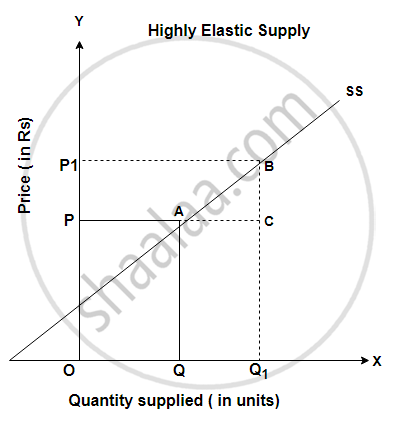
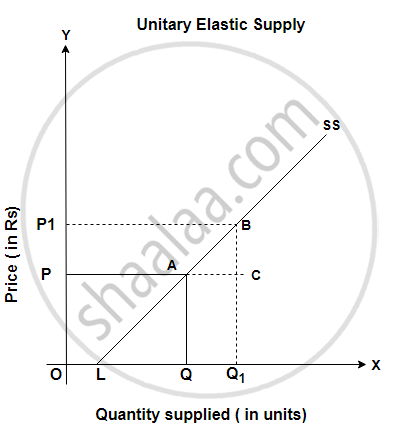
- Unitary Elastic Supply (Es = 1): If the straight-line supply curve passes through the origin (supply curve SS in fig.), then the elasticity of supply will be equal to one. In the diagram, Elasticity of Supply (Es) = `(OQ)/(OQ)` = 1. Hence, the supply is unitary elastic.
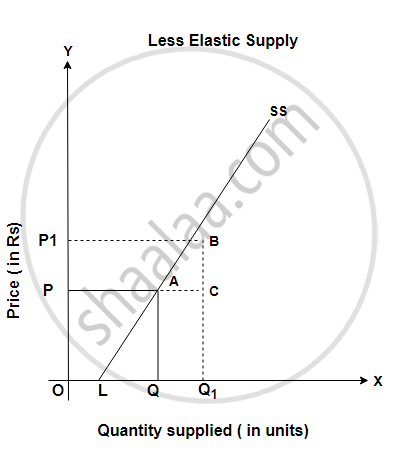
- Less Elastic Supply (Es < 1): If a supply curve meets the X-axis at some point, say, L in Fig., then supply is inelastic. As seen in the fig., Es = `(LQ)/(OQ)` and LQ < OQ. So, Es < 1, i.e., supply is less elastic.
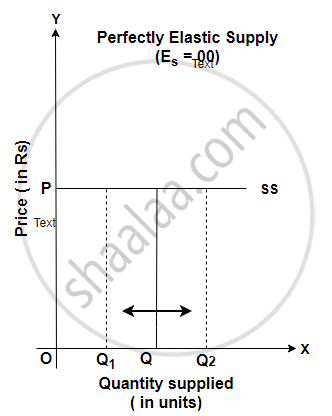
- Perfectly Elastic Supply: When there is an infinite supply at a particular price, and the supply becomes zero with a slight fall in price, then the supply of such a commodity is said to be perfectly elastic. In such a case,
- Es = Y and the supply curve is a horizontal straight line parallel to the X-axis, as shown in fig.
- Perfectly Inelastic Supply: When the supply does not change with a change in price, then the supply for such a commodity is said to be perfectly inelastic. In such a case, Es = 0 and the supply curve (SS) is a vertical straight line parallel to the Y-axis, as shown in fig.
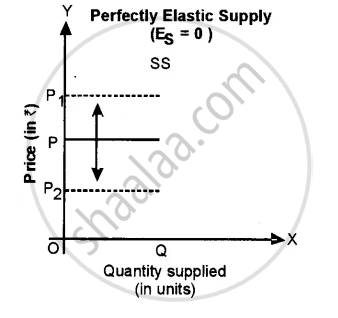
Solution 2
The geometric method is used to measure the elasticity of supply at a point on the supply curve. That is why it is also known as the point method.
(1)
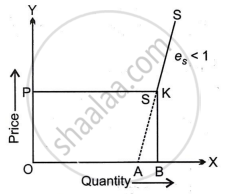
Point K indicates that at the OP price, the quantity supplied is OB. The elasticity of supply at point K on the supply curve SS is calculated by the formula `"AB"/"OB"`, i.e., the ratio of the horizontal segment AB divided by the quantity supplied OB.
AB is smaller than OB. Therefore, the elasticity of supply `"AB"/"OB" < 1`.
(2)
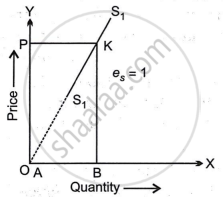
Supply curve S1S1, when extended, meets the X-axis at the point of origin so that AB = OB. Therefore, at point k on S1S1, the elasticity of supply `"AB"/"OB" = 1`.
(3)
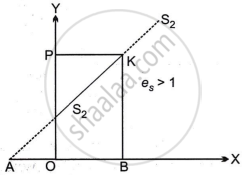
Supply curve S2S2 wheri extended meets the X-axis to the left of the point of origin so that AB is greater than OB. Therefore, the elasticity of supply `"AB"/"OB" > 1`.
Notes
Students should refer to the answer according to their preferred marks.
