Advertisements
Advertisements
Question
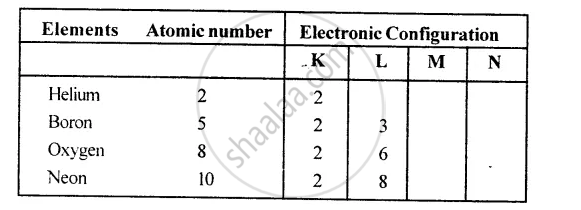
Explain the rule with example according to which electrons are filled in various energy levels
Advertisements
Solution
The maximum number of electrons that can be present in any shell or orbit of an atom is given by the formula 2n2, where n is the serial number of the shell.
Therefore:
K shell, n = 1, no. of electrons = 2 x 12 = 2
L shell, n = 2, no. of electrons = 2 x 22 = 8
M shell, n = 3, no. of electrons = 2 x 32 = 18
N shell, n = 4, no. of electrons = 2 x 42= 32
Electrons are not accommodated in a given shell, unless the inner shells are filled.
That is, the shells are filled in a stepwise manner
APPEARS IN
RELATED QUESTIONS
Write true or false for the following statement
The central pad of the atom is called nucleus.
Give the following a suitable word/phrase
Arrangement of electrons in the shells of an atom.
Define the term Atomic number.
Mention briefly the salient features of Dalton’s atomic theory (five points)
What are the observations of the experiment done by Rutherford in order to determine the structure of an atom?
Tick the most appropriate answer.
How many times is a proton heavier than an electron?
- 1500
- 1800
- 1840
- none of these
WRITE SHORT ANSWER
What is an atom?
WRITE SHORT ANSWER
What do you mean by electron transition?
Fill in the blank of the following statement :
The electron has _________ charge, the proton has _________ charge, and the neutron has _________ charge.
Select the correct answer from the choice in the bracket to complete the sentence:
A ________ is a sub-atomic particle with no charge and unit mass.
