Advertisements
Advertisements
Question
Explain in detail the inter-relationship between the food chain and the food web.
Advertisements
Solution
Between producers, consumers, and decomposers, interaction is constant. There is a definite sequence in these interactions, which is called the food chain. Each chain consists of four, five or more links. An ecosystem consists of many food chains that are interconnected at various levels. Thus, a food web is formed. An organism may be the prey of many other organisms. For example, an insect feeds upon the leaves of various plants, but the same insect is the prey for different animals like frogs, wall lizards, birds, etc. Thus, many interconnected food chains form an intricate food web.
APPEARS IN
RELATED QUESTIONS
Who eats birds?
What is the deer’s food?
What is food for the tiger?
Find the different food chains of which the worm and the mouse form a link.

Use your brain power!
Make up a food chain: Frog, kite, worm, snake, grass.
What is a food chain? Give an example of it.
Observe the food web and answer the questions given below:
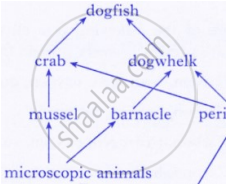
The mussel can be described as:
A food web is very useful to show the many different feeding relationships between different species within an ecosystem.
Organisms of a higher trophic level which feed on several types of organisms belonging to a lower trophic level constitute the
Draw a diagram showing flow of energy from solar input to a food chain having four trophic levels in an ecosystem. List two inference that can be drawn from the energy flow diagram.
Study the given figure of a Food web and identify the primary consumer in the food web:

How do food chains exist in natural conditions?
A food web establishes relationships between various species within which setting?
What results from a greater number of dietary alternatives for consumers?
How is the flow of energy through an ecosystem described?
What happens to the amount of available energy as energy moves progressively through successive trophic levels?
Why does the maximum concentration of toxic chemicals ultimately accumulate in human bodies?
