Advertisements
Advertisements
Question
Explain in detail how ‘Dyslexia’ differs from ‘Dysgraphia’.
Advertisements
Solution
- Dyslexia (words or reading): Dyslexia is the most common form of all learning disabilities. It is a language-based disability in which a person has trouble understanding words, sentences, or paragraphs. People with dyslexia often have problems with processing or understanding what they read or hear. Many dyslexic people are notably talented in arts and music, 3-D visual perception, and athletic and mechanical ability. Dyslexia may also be referred to as a reading disability or reading disorder. Some people struggle with phonemic awareness, which means they fail to recognise the way words break down according to sound. Students cannot distinguish between same sounding words. Other issues relate to fluency, spelling, comprehension, and more.
- Dysgraphia (graphics): Dysgraphia is related to the physical act of writing. It is a writing disability where people find it hard to form letters and write within a defined space. Many people with dysgraphia have handwriting that is uneven and inconsistent. Many are able to write legibly but do so very slowly or in very small fonts. Typically, people with dysgraphia cannot visualise letters and do not possess the ability to remember the motor patterns of letters. They require an extensive amount of energy and time to write. These students often cannot hold a pencil correctly, and their posture may be tense while trying to write. This leads them to tire easily, causing discouragement that further inhibits progress. These students have trouble organising their thoughts coherently. Their writing may be redundant or have obvious omissions that affect the quality and readability of the text. They may also struggle with basic sentence structure and grammatical awareness.
APPEARS IN
RELATED QUESTIONS
List any two characteristics seen in a dyslexic child.
Discuss the role of parents in handling children with learning disabilities.
Amit is in the fifth grade who is easily distracted in class and is unable to pay constant attention.
Name the learning disability Amit may be suffering from.
Identify the picture.
 |
This child is finding the lesson boring. Identify the picture and select the correct learning disability.
Identify the picture.
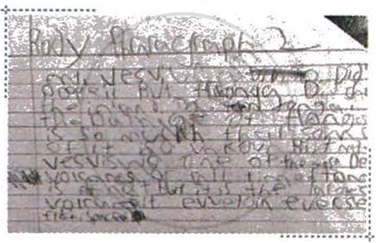 |
Identify the learning disability with this picture.
Select the odd one:
Dyscalculia is
- Disability to grasp and solve maths concepts
- Difficulty in manipulating numbers in their heads
- Struggling with phonemic awareness
- Difficulty in remembering equations
Select the odd one:
Learning disabilities are
- Always genetic
- Interfere with attention
- Connect to processing deficit
- Not curable
What are struggle areas for children with ‘Dyscalculia’?
What are auditory learning disabilities?
Describe the main learning disabilities in brief.
