Advertisements
Advertisements
Question
Explain in brief the experimental proof which led to the discovery of –
Neutrons
Advertisements
Solution
Discovery of Neutrons: As atom contains protons and electrons. The atomic mass of the electron is negligible.
∴ An atom of helium which contains 2 protons should have a mass = (2 × 1) + 0 = 2 a.m.u. But the atomic mass of a helium atom was found to be approximately 4.0 a.m.u. It was, therefore, proved that, in the nucleus of an atom, there is another particle called a neutron which has no electrical charge but is almost of an equal mass as the protons.
APPEARS IN
RELATED QUESTIONS
Helium atom has an atomic mass of 4 u and two protons in its nucleus. How many neutrons does it have?
Compare the properties of electrons, protons and neutrons.
Which subatomic particle is not present in an ordinary hydrogen atom?
Fill in the blank of the following statement :
The subatomic particle not present in a hydrogen atom is ________
Sulphur has an atomic number of 16 and a mass number of 32. State the number of protons and neutrons present in the nucleus of sulphur.
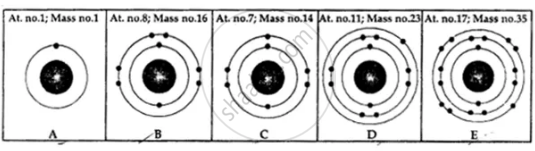
State the number of neutrons in each of the atoms A to E. Also state which of the atoms A to E is a metal.
Calculate the number of neutrons, protons and electrons:
- atomic number 3 and mass number 7
- atomic number 92 and mass number 238.
Calculate the number of neutrons present in the nucleus of an element X which is represented as `""_15^31"X"`
Isotopes exist because atoms of the same element can have different numbers of ______.
Which subatomic particles have no charge?
