Advertisements
Advertisements
Questions
Explain briefly the structure of the earth.
Discuss the structure of the earth giving details about each of its layers and arguments in support of your contention.
Describe the structure of the Earth.
Advertisements
Solution
The structure of the earth means the interior of the earth.
The entire earth is composed of three zones
- Lithosphere
- Mesosphere and
- Barysphere.
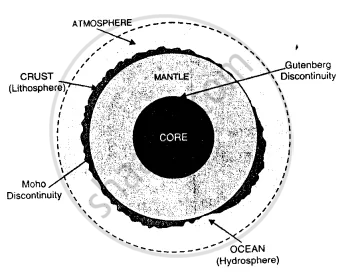
The Crust or Lithosphere It is the outermost layer. Its thickness varies from 8 to 60 kms. It is solid and is formed largely of igneous rocks. The crust consists of two layers.
- a lower, continuous layer of basaltic (mafic) rocks and
- and upper layer of granitic (felsic) rock, which constitutes bulk of continents. It is absent in ocean basins. These parts of the crust forming the continents are much thicker than the crust under the oceans. Its main universal constituents are Silica and Aluminium. It is collectively known as ‘SIAL’. It has an average density of 2.7. The lower layer has an average density of 3.0. It main mineral constituents are Silica (SI) and Magnesium (MA) and is therefore called ‘SIMA’. Since the SIAL is lighter than the SIMA, the continents can be said to be floating on the layer of denser SIMA.
(ii) Mantle or The Mesosphere Beneath the crust or Lithosphere lies the Mantle or Mesosphere. Its thickness is 2840 km. Its density is 3.1 to 5.0. It depth is 2900 km. It is again divided into two sub layers.
- the internal Silicate layer (SIMA). Its thickness is 1140 km and density varies from 3.1 to 4.75 and
- Mixed layer of metals and silicates. Its thickness is 1700 kms. and density is 4.75 – 5.0.
(iii) Core or the Barysphere It is the central nucleus. It is made up of dense rock materials – Nickel and Iron. It is also called the layer ‘NIFE’. Its thickness is 3471 km (radius of core). It is again divided into two sub-layer
- The outer core is liquid or plastic in nature and
- Inner core (Barysphere) which is solid and rigid because of tremendous overlying pressure. The density of core is 5.1 to 13.
APPEARS IN
RELATED QUESTIONS
Give a geographical reason for the following:
The inner core of the earth is in a solid state.
Study the figure on the side and answer the question

What is known as Sial? How deep is the area marked by Sial?
Where is Mantle located in the Earth?
Give one word for the following :
A narrow block elevated between two normal faults.
______ layer is made up of liquid iron.
Mention the layers of the interior of the Earth.
The presence of large quantities of ______ in the core is responsible for the Earth’s Gravitational force.
What is SIAL?
What is NIFE?
Seismology deals with ______.
