Advertisements
Advertisements
Questions
Explain any four determinants of elasticity of supply.
Explain three determinants of elasticity of supply.
Explain the factors determining price elasticity of supply.
Give any four determinants of elasticity of supply.
Advertisements
Solution
- Nature of Inputs used: The elasticity of supply depends on the nature of inputs used for the production of a commodity. If commonly available inputs are used, supply will be elastic. If inputs used are not commonly available, supply will be inelastic.
- Time period: Elasticity of supply also depends upon the length of time for response. It may be difficult to change quantity of supply in few weeks or months in response to price change but easy to do so over a period of year. Therefore, supply is relatively inelastic in the short run and relatively elastic in the long run.
- Nature of commodity produced: The supply of durable goods is relatively elastic. Durable goods can be stored and hence producers can meet the changing market demand either by running down their stocks or by building up stocks. On the other hand, supply of perishable goods is relatively inelastic because these goods cannot be stored for long. These goods have to be sold out.
- Cost of production: Elasticity of supply is also influenced by cost of production. If an increase in output by the firms in an industry causes only a small increase or decrease in cost per unit of output, supply will be more elastic. On the other hand, if an increase in supply leads to a large increase in cost of production, the supply will be relatively inelastic.
APPEARS IN
RELATED QUESTIONS
Draw a perfectly inelastic supply curve.
With the help of a suitable diagram, explain the following degree of elasticity of supply.
Es = ∞
Draw a perfectly elastic supply curve.

Identify the elasticity of supply (es) of S1, S2 and S3 supply curves:
Identify the elasticity of supply for the following with proper reasoning:
Short run and long run period.
Which of the following measures of price elasticity shows elasticity shows elastic supply?
If price elasticity of supply is greater than 1, then supply is said be elastic.
- Price elasticity of supply of a good is 0.8, its supply is said to be inelastic.
- If the quantity supplied of a commodity remain the same whatever its price supply is said to perfectly inelastic.
The given diagram is a case of ______ supply.

Which of the following statements are true?
The cost of production will increase if
- The government gives subsidies
- The firm uses obsolete technology
- The price of diesel increases
When the price increases by 50% and the supply increases only by 5% the price elasticity of supply of that commodity will be ______.
If the price elsaticity of supply is 1 and the percentage change in price is 10, then the percentage change in quatity supplied should be ______.
Pick the option which does not belong to the group.
A linear supply curve starting from the origin making an angle of 75 degree with X-axis will have ______.
Identify the correct sequence of alternatives given in Column II by matching them with respective terms in Column I:
| Column I | Column II |
| A. Perfectly Inelastic | (i) Es > 1 |
| B. Perfectly Elastic | (ii) Es < 1 |
| C. Inelastic | (iii) Es = 0 |
| D. Highly Elastic | (iv) Es = infinity |
Choose the correct alternative:
Define elasticity of supply.
With the help of a formula calculate the elasticity of supply from the following table:
| Price | Quantity supplied |
| 10 | 200 |
| 15 | 225 |
When there is no change in price, but quality supplied changes, it implies a situation of ______.
Cotton and cotton seeds are examples of ______ supply.
Draw and briefly explain a perfectly elastic supply curve.
If the price of a commodity increases by 50% and its supply increases by 25% then calculate the price elasticity of supply following the percentage method. Identify the degree of price elasticity.
How is elasticity of supply measured according to the percentage method?
Define price elasticity of supply.
Draw the supply curve showing price elasticity of supply less than one.
Indicate the degree of elasticity on the supply curve given below:
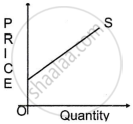
Draw and explain the following degree of elasticity of supply.
Ep > 1
Identify and define the degree of price elasticity of supply from the diagram for the supply curves S1, S2, S3, S4.
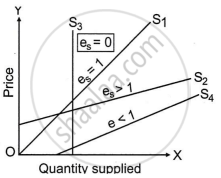
What is meant by elasticity of supply?
Using graphs, explain any four types of elasticity of supply.
What is meant by inelastic supply?
What do you mean by elastic supply?
What do you mean by perfectly inelastic supply?
Price elasticity of supply of a good is 0.8. Is the supply 'elastic' or 'inelastic', and why?
Why is the supply of eggs inelastic?
Explain the percentage method of measuring price elasticity of supply.
Draw a straight line supply curve of the following situation.
More than unitary elastic
