Advertisements
Advertisements
Question
Examine the Fig.
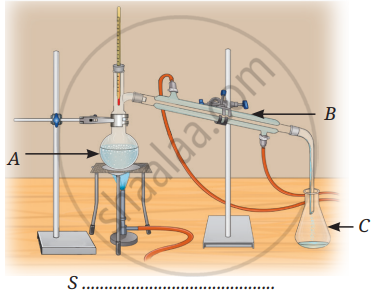
- Identify the separation technique marked as ‘S’.
- Label the apparatus A, B and C.
- Which of the following mixtures can be separated by the technique identified above? Use the data given in the Table. Mixtures:
- water - acetone
- water - salt
- acetone - alcohol
- sand - salt
- alcohol - chloroform
- alcohol - benzene
| Boiling points of some compounds | |||||
| Solvent | Water | Acetone | Alcohol | Chloroform | Chloroform |
| Temperature (°C) | 100°C | 56°C | 78°C | 61°C | 80°C |
Very Long Answer
Advertisements
Solution
(i) The separation technique marked as 'S' is distillation.
(ii) The labelled apparatus are:
- A - Distillation flask
- B - Water condenser
- C - Conical flask
(iii) Distillation is used to separate a liquid from a solution containing a dissolved solid, and it can also separate two miscible liquids if their boiling points differ by about 25 °C or more.
- Water – acetone: The boiling points differ by 44°C (100 − 56). Since this is more than 25°C, these two liquids can be separated by distillation.
- Water – salt: Salt is dissolved in water, so water can be obtained from the solution using distillation.
- Acetone – alcohol: The difference in boiling points is 22°C (78 − 56). Since this is less than 25°C, simple distillation is not suitable.
- Sand – salt: Both substances are solids, so distillation cannot be used to separate them.
- Alcohol – chloroform: The boiling point difference is 17°C (78 − 61), which is below 25°C, so simple distillation is not effective.
- Alcohol – benzene: The difference is only 2°C (80 − 78), so they cannot be separated by simple distillation.
Only mixtures (a) water–acetone and (b) water–salt solution can be separated using distillation.
shaalaa.com
Is there an error in this question or solution?
