Advertisements
Advertisements
Question
Examine the continuity of the function
\[f\left( x \right) = \left\{ \begin{array}{l}3x - 2, & x \leq 0 \\ x + 1 , & x > 0\end{array}at x = 0 \right.\]
Also sketch the graph of this function.
Advertisements
Solution
Meaning of continuity of function - If we talk about a general meaning of continuity of a function f(x) , we can say that if we plot the coordinates (x, f(x)) and try to join all those points in the specified region, we can do so without picking our pen i.e you will put your pen/pencil on graph paper and you can draw the curve without any breakage.
Mathematically we define the same thing as given below:
A function f(x) is said to be continuous at x = c where c is x-coordinate of the point at which continuity is to be checked
If:
`lim_(h->0)f(c - h) = lim_(h->0)f(c + h) = f(c)`
where h is a very small positive no (can assume h = 0.00000000001 like this)
It means :-
Limiting value of the left neighbourhood of x = c also called left hand limit LHL `{i.e lim_(h->0)f(c - h)}` must be equal to limiting value of right neighbourhood of x= c called right hand limit RHL `{i.e lim_(h->0)f(c + h)}` and both must be equal to the value of f(x) at x = c i.e. f(c).
Thus, it is the necessary condition for a function to be continuous.
So, whenever we check continuity we try to check above equality if it holds true, function is continuous else it is discontinuous.
Lets solve now:
Given function is
f(x) = `{(3x - 2, if x ≤ 0),(x + 1, if x > 0):}` ...(2)
We need to check whether f(x) is continuous at x=0 or not
For this we need to check LHL, RHL and value of function at x = 0
Clearly,
f(0) = 3*0 - 2 = -2 [from equation 2]
LHL = `lim_(h->0)f(0 - h) = lim_(h->0)f(-h) = lim_(h->0){3(-h)-2} = -2`
RHL = `lim_(h->0)f(0 + h) = lim_(h->0)f(h) = lim_(h->0){h + 1} = 0 + 1 = 1`
As, LHL ≠ RHL
f(x) is discontinuous at x = 0
This can also be proved by plotting f(x) on cartesian plane.
For x >0, we need to plot
y = x + 1
put y = 0, we get x = -1 and for second point we put x = 0 and thus get y=1
two points are enough to plot the straight line.
Two coordinates are (-1,0) and (0,1)
For x ≤ 0, we need to plot
y = 3x - 2
put x = 0 then y = -2
on putting y = 0 we get x 2/3
two coordinates are (0, -2) and `(2/3, 0)`
Graph:
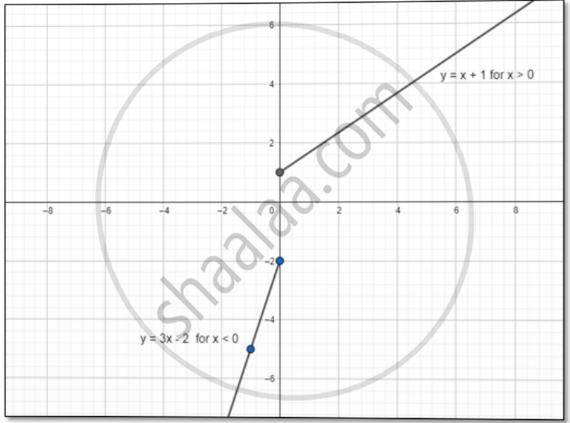
APPEARS IN
RELATED QUESTIONS
Find the relationship between a and b so that the function f defined by f(x) = `{(ax + 1", if" x<= 3),(bx + 3", if" x > 3):}` is continuous at x = 3.
Discuss the continuity of the following function:
f(x) = sin x × cos x
Find the value of k so that the function f is continuous at the indicated point.
f(x) = `{((kcosx)/(pi-2x)", if" x != pi/2),(3", if" x = pi/2):}` at x = `"pi/2`
Show that the function defined by f(x) = cos (x2) is a continuous function.
Let \[f\left( x \right) = \frac{\log\left( 1 + \frac{x}{a} \right) - \log\left( 1 - \frac{x}{b} \right)}{x}\] x ≠ 0. Find the value of f at x = 0 so that f becomes continuous at x = 0.
Extend the definition of the following by continuity
In each of the following, find the value of the constant k so that the given function is continuous at the indicated point; \[f\left( x \right) = \begin{cases}(x - 1)\tan\frac{\pi x}{2}, \text{ if } & x \neq 1 \\ k , if & x = 1\end{cases}\] at x = 1at x = 1
Find the values of a and b so that the function f given by \[f\left( x \right) = \begin{cases}1 , & \text{ if } x \leq 3 \\ ax + b , & \text{ if } 3 < x < 5 \\ 7 , & \text{ if } x \geq 5\end{cases}\] is continuous at x = 3 and x = 5.
Prove that the function \[f\left( x \right) = \begin{cases}\frac{\sin x}{x}, & x < 0 \\ x + 1, & x \geq 0\end{cases}\] is everywhere continuous.
Find the points of discontinuity, if any, of the following functions: \[f\left( x \right) = \begin{cases}\frac{x^4 - 16}{x - 2}, & \text{ if } x \neq 2 \\ 16 , & \text{ if } x = 2\end{cases}\]
Find the points of discontinuity, if any, of the following functions: \[f\left( x \right) = \begin{cases}\frac{\sin x}{x}, & \text{ if } x < 0 \\ 2x + 3, & x \geq 0\end{cases}\]
In the following, determine the value of constant involved in the definition so that the given function is continuou: \[f\left( x \right) = \begin{cases}\frac{\sin 2x}{5x}, & \text{ if } x \neq 0 \\ 3k , & \text{ if } x = 0\end{cases}\]
The function f(x) is defined as follows:
If f is continuous on [0, 8], find the values of a and b.
Discuss the continuity of the following functions:
(i) f(x) = sin x + cos x
(ii) f(x) = sin x − cos x
(iii) f(x) = sin x cos x
Show that f (x) = | cos x | is a continuous function.
What happens to a function f (x) at x = a, if
If the function \[f\left( x \right) = \frac{\sin 10x}{x}, x \neq 0\] is continuous at x = 0, find f (0).
If \[f\left( x \right) = \begin{cases}\frac{1 - \sin x}{\left( \pi - 2x \right)^2} . \frac{\log \sin x}{\log\left( 1 + \pi^2 - 4\pi x + 4 x^2 \right)}, & x \neq \frac{\pi}{2} \\ k , & x = \frac{\pi}{2}\end{cases}\]is continuous at x = π/2, then k =
The function
If \[f\left( x \right) = \frac{1 - \sin x}{\left( \pi - 2x \right)^2},\] when x ≠ π/2 and f (π/2) = λ, then f (x) will be continuous function at x= π/2, where λ =
Let \[f\left( x \right) = \frac{\tan\left( \frac{\pi}{4} - x \right)}{\cot 2x}, x \neq \frac{\pi}{4} .\] The value which should be assigned to f (x) at \[x = \frac{\pi}{4},\]so that it is continuous everywhere is
If f is defined by \[f\left( x \right) = x^2 - 4x + 7\] , show that \[f'\left( 5 \right) = 2f'\left( \frac{7}{2} \right)\]
If \[f\left( x \right) = \begin{cases}\frac{\left| x + 2 \right|}{\tan^{- 1} \left( x + 2 \right)} & , x \neq - 2 \\ 2 & , x = - 2\end{cases}\] then f (x) is
The function f (x) = 1 + |cos x| is
`lim_("x"-> pi) (1 + "cos"^2 "x")/("x" - pi)^2` is equal to ____________.
`lim_("x" -> 0) (1 - "cos x")/"x sin x"` is equal to ____________.
The point(s), at which the function f given by f(x) = `{("x"/|"x"|"," "x" < 0),(-1"," "x" ≥ 0):}` is continuous, is/are:
A real value of x satisfies `((3 - 4ix)/(3 + 4ix))` = α – iβ (α, β ∈ R), if α2 + β2 is equal to
If `f(x) = {{:(-x^2",", "when" x ≤ 0),(5x - 4",", "when" 0 < x ≤ 1),(4x^2 - 3x",", "when" 1 < x < 2),(3x + 4",", "when" x ≥ 2):}`, then
The value of ‘k’ for which the function f(x) = `{{:((1 - cos4x)/(8x^2)",", if x ≠ 0),(k",", if x = 0):}` is continuous at x = 0 is ______.
Discuss the continuity of the following function:
f(x) = sin x – cos x
Which conditions guarantee that \[f\circ g\] is continuous at \[c\]?
Why is \[f(x)=\sin(x^2)\] continuous for all real \[x\]?
