Advertisements
Advertisements
Question
Draw a labelled ray diagram of an astronomical telescope to show the image formation of a distant object. Write the main considerations required in selecting the objective and eyepiece lenses in order to have large magnifying power and high resolution of the telescope.
Advertisements
Solution
Astronomical telescope
When the final image is formed at the least distance of distinct vision:
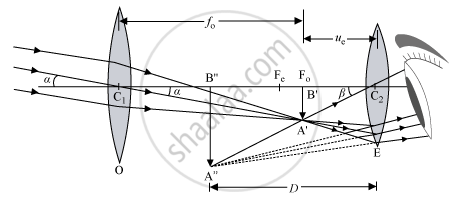
Magnifying power, `M =β/α`
Since α and β are small, we have:
∴ `M= tanβ/tanα ...... (1)`
In `ΔA'B'C_2, tanβ = (A'B')/(C_2B') `
In `ΔA'B'C_1, tanβ = (A'B')/(C_2B') `
From equation (i), we get:
`M = (A'B')/(C_2B') xx (C_1B')/(A'B')`
\[\Rightarrow\] `M = (C_1B')/(C_2B')`
Here, `C_1B' = +f_0`
\[\Rightarrow\] `C_2B' = -u_e`
\[\Rightarrow\] `M = f_0/ -u_e .......... (2)`
Using the lens equation `(1/v-1/u=1/f)`for the eyepieces `(1/-D-1/-u_e=1/f_e,)`we get:
`(-1/D+1/u_e=1/f_e)`
\[\Rightarrow\] `(1/u_e=1/(f_e)+1/D)`
\[\Rightarrow\] `(f_0)/u_e =(f_0)/(f_e )(1+f_e/D)`
\[\Rightarrow\] `(-f_0)/u_e =(-f_0)/(f_e )(1+f_e/D) or M = -f_0/(f_e) (1+f_e/D) `
In order to have a large magnifying power and high resolution of the telescope, its objective lens should have a large focal length and the eyepiece lens should have a short focal length.
RELATED QUESTIONS
- A giant refracting telescope at an observatory has an objective lens of focal length 15 m. If an eyepiece of focal length 1.0 cm is used, what is the angular magnification of the telescope?
- If this telescope is used to view the moon, what is the diameter of the image of the moon formed by the objective lens? The diameter of the moon is 3.48 × 10⁶ m, and the radius of lunar orbit is 3.8 × 10⁸ m.
You are given three lenses of power 0.5 D, 4 D, and 10 D to design a telescope.
1) Which lenses should be used as objective and eyepiece? Justify your answer.
2) Why is the aperture of the objective preferred to be large?
Describe briefly the two main limitations and explain how far these can be minimized in a reflecting telescope ?
Write two important limitations of a refracting telescope over a reflecting-type telescope.
A small telescope has an objective lens of focal length 150 cm and an eye piece of focal length 5 cm. If this telescope is used to view a 100 m high tower 3 km away, find the height of the final image when it is formed 25 cm away from the eye piece.
Draw a labeled ray diagram of a reflecting telescope. Mention its two advantages over the refracting telescope.
A Galilean telescope is 27 cm long when focussed to form an image at infinity. If the objective has a focal length of 30 cm, what is the focal length of the eyepiece?
Draw a ray diagram of Astronomical Telescope for the final image formed at infinity
Read the following paragraph and answer the questions.
| A number of optical devices and instruments have been designed and developed such as periscope, binoculars, microscopes and telescopes utilising the reflecting and refracting properties of mirrors, lenses and prisms. Most of them are in common use. Our knowledge about the formation of images by the mirrors and lenses is the basic requirement for understanding the working of these devices. |
- Why the image formed at infinity is often considered most suitable for viewing. Explain
- In modern microscopes, multicomponent lenses are used for both the objective and the eyepiece. Why?
- Write two points of difference between a compound microscope and an astronomical telescope
OR
Write two distinct advantages of a reflecting type telescope over a refracting type telescope.
A small telescope has an objective of focal length 140 cm and an eye piece of focal length 5.0 cm. The magnifying power of telescope for viewing a distant object?
