Advertisements
Advertisements
Question
Draw any angle with vertex O. Take a point A on one of its arms and B on another such that OA = OB. Draw the perpendicular bisectors of `overline"OA"` and `overline"OB"`. Let them meet at P. Is PA = PB ?
Answer in Brief
Diagram
Advertisements
Solution
- Draw any angle whose vertex is O.
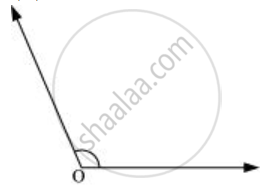
- With a convenient radius, draw arcs on both rays of this angle while taking O as centre. Let these points be A and B.
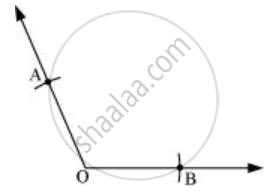
- Taking O and A as centres and with radius more than half of OA, draw arcs on both sides of OA. Let these be intersecting at C and D. Join CD.
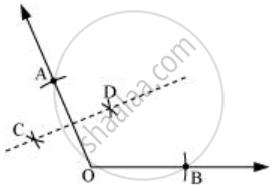
-
Similarly, we can find the perpendicular bisector `overline"EF"` of `overline"OB"`. These perpendicular bisectors `overline"CD"` and `overline"EF"` will intersect each other at P.
Now, PA and PB can be measured. These are equal in length.
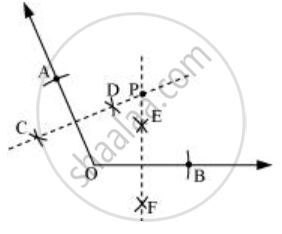
shaalaa.com
Is there an error in this question or solution?
