Advertisements
Advertisements
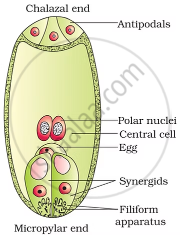
Question
- Nucellus
- Antipodals
- Synergids
- Micropyle
Advertisements
Solution
APPEARS IN
RELATED QUESTIONS
Why does self-pollination not lead to seed formation in self-incompatible species?
Complete the following chart and rewrite.
| Sr.No. | Agencies | type of pollination |
| 1 | Water | .................... |
| 2 | ........................... | Entomophily |
| 3 | Bat | .................... |
| 4 | ....................... | Ornithophily |
(Or)
Explain outbreeding devices in angiospermic plants.
Give one word/term for the following:
When stigma and anthers do not grow up to the same height, which favors only cross-pollination.
Name the two types of pollination.
A particular species of plant produces light, non-sticky pollen in large numbers and its stigmas are long and feathery. These modifications facilitate pollination by ______.
Triple fusion in Capsella bursa pastoris is fusion of male gamete with ______.
Heterostyly as a contrivance for cross-pollination is found in ______.
Which of the following plant contain unisexual flower?
In the dioecious aquatic plant shown, identify the characteristics of the male flowers that reach the female flowers for pollination:

| Size of the flower | Colour of flower | The characteristic feature of pollen grain | |
| A | small | brightly coloured | Lightweight and non-sticky |
| B | large | colourless | large and sticky |
| C | small | white | small, covered with mucilage |
| D | large | colourless | non-sticky |
Identify the set of correct statements:
- The flowers of Vallisneria are colourful and produce nectar.
- The flowers of waterlily are not pollinated by water.
- In most of water-pollinated species, the pollen grains are protected from wetting.
- Pollen grains of some hydrophytes are long and ribbon like.
- In some hydrophytes, the pollen grains are carried passively inside water.
Choose the correct answer from the options given below:
