Advertisements
Advertisements
Questions
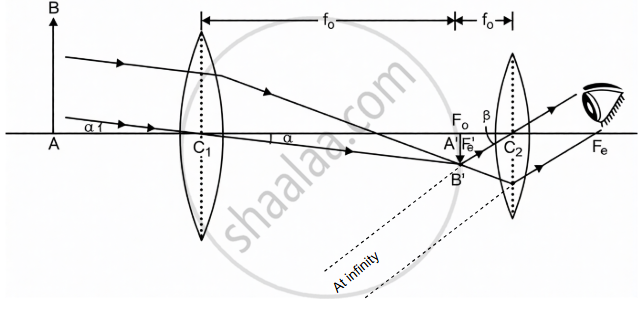
Draw a ray diagram of Astronomical Telescope for the final image formed at infinity
Draw a labelled diagram of an astronomical telescope when its final image lies at infinity.
Advertisements
Solution
RELATED QUESTIONS
Draw a labeled ray diagram to obtain the real image formed by an astronomical telescope in normal adjustment position. Define its magnifying power.
A small telescope has an objective lens of focal length 144 cm and an eyepiece of focal length 6.0 cm. What is the magnifying power of the telescope? What is the separation between the objective and the eyepiece?
Write two important advantages of reflecting telescope over a refracting telescope.
You are given three lenses of power 0.5 D, 4 D, and 10 D to design a telescope.
1) Which lenses should be used as objective and eyepiece? Justify your answer.
2) Why is the aperture of the objective preferred to be large?
Describe briefly the two main limitations and explain how far these can be minimized in a reflecting telescope ?
Define magnifying power of a telescope. Write its expression.
Draw a labeled ray diagram of a reflecting telescope. Mention its two advantages over the refracting telescope.
(i) What is meant by resolving power of a telescope?
(ii) State any one method of increasing the resolving power of an astronomical telescope.
Draw a labelled ray diagram of an astronomical telescope in the near point adjustment position. A giant refracting telescope at an observatory has an objective lens of focal length 15 m and an eyepiece of focal length 1.0 cm. If this telescope is used to view the Moon, find the diameter of the image of the Moon formed by the objective lens. The diameter of the Moon is `3.48 xx 10^6`m, and the radius of the lunar orbit is `3.48 xx 10^8`m.
Define the term ‘resolving power of a telescope’.
