Advertisements
Advertisements
Question
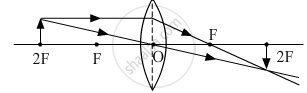
Draw a ray diagram in each of the following cases to show the formation of image, when the object is placed :
(i) between the optical centre and principal focus of a convex lens.
(ii) anywhere in front of a concave lens.
(iii) at 2F of a convex lens.
State the signs and values of magnifications in the above-mentioned cases (i) and (ii).
Advertisements
Solution
(i) When an object is placed between the optical center and principal focus of a convex lens
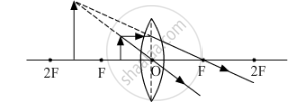
Since the image formed is virtual and erect so sign of magnification will be positive. Moreover, the image formed is magnified therefore the absolute value of magnification will be greater than one.
(ii) When an object is placed anywhere in front of a concave lens.
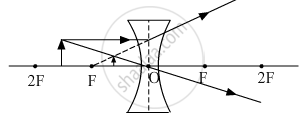
Since the image formed is virtual and erect so sign of magnification will be positive. Moreover, the image formed is diminished therefore the absolute value of magnification will be less than one.
(iii) When an object is placed at 2F of a convex lens.
APPEARS IN
RELATED QUESTIONS
An image which can be obtained on a screen is called a ______ image.
We can obtain a real, enlarged and inverted image by a concave mirror.
What is the relation between the focal length and radius of curvature of a spherical mirror (concave mirror of convex mirror)? Calculate the focal length of a spherical mirror whose radius of curvature is 25 cm.
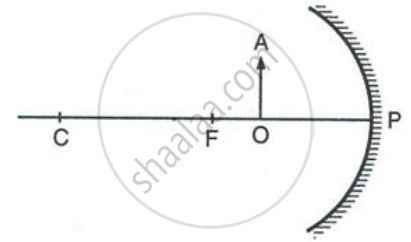
Figure shows a concave mirror with its pole at P, focus F and centre of curvature C. Draw ray diagram to show the formation of image of an object OA.
A real and enlarged image can be obtained by using a
The image formed by a convex mirror is of size one third the size of object. How are u and v related?
What do you understand by the term real image?
Find the height of the image of a body of height 1.5m in a mirror with a magnification of 1.5.
